An Engineering Insight authored by SK&A Associate Nima Arjomandnia, PE, PMP. Follow Nima on LinkedIn.
Why vibration control belongs in the earliest conversations about hospitality and residential design.
A subway rumbles past at 2 a.m. A pile driver starts up next door mid-project. To most people, that’s just city noise. To a guest lying in a $400-a-night room, it’s a one-star review.
Ground-borne vibration is one of the most underrated risks in hospitality and residential design. And one of the most fixable, if you design for it early. There are many isolation systems under footings, I want to share elastomeric bearing pads that are often the most practical first line of defense, and how to think about the broader isolation toolkit.
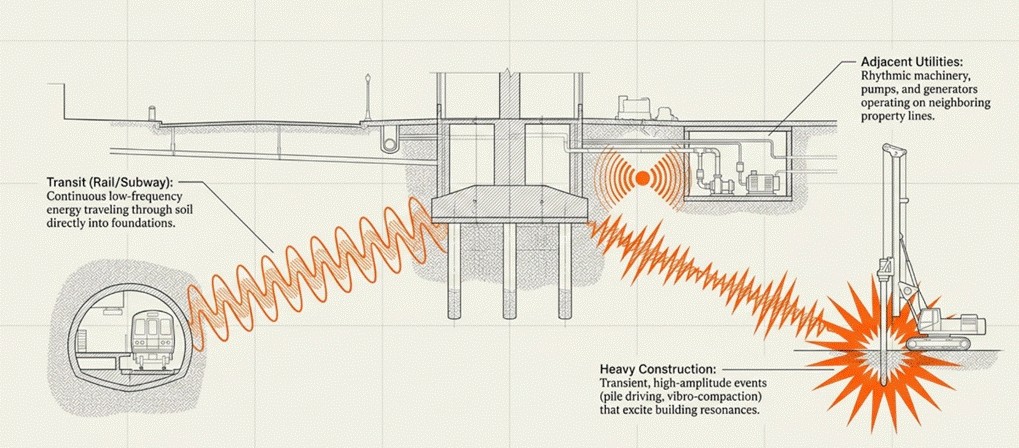
Typical sources of vibration on foundation
Why This Matters More Than People Think
 Occupant comfort is revenue. Guests notice rhythmic vibration and low-frequency rumble even when they can’t name it. In hospitality, that translates directly into reviews and repeat bookings.
Sensitive elements take the hit first. Luxury rooms, acoustically tuned rooms, conference spaces, hospital or research labs and MEP equipment all degrade under persistent vibration, often before anyone files a complaint.
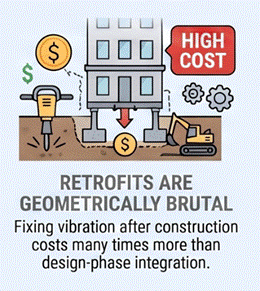
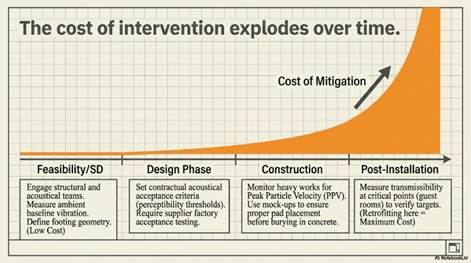
Retrofits are brutal. Adding isolation after the building is up costs a multiple of what it would have cost in the foundation design phase. This is a problem you solve on paper, not on a punch list.
Where the Vibration Actually Comes From
- Transit systems: continuous, low-frequency energy transmitted through soil into the foundation
- Construction activity: pile driving and vibro-compaction, which can also excite building resonances
- Neighboring equipment: pumps, generators, and mechanical systems from adjacent properties
The Isolation Solutions, in Brief
Before we go deep on elastomeric pads, here’s the rest of the toolkit in a sentence each:
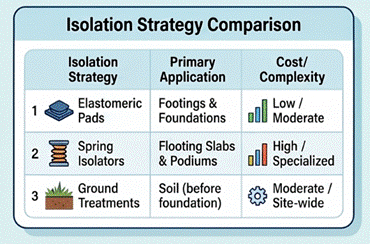
- Elastomeric bearings pads: the use of elastic material to reduce vibration and noise, a flexible rubber type material is used in steel and concrete construction and mainly used under foundations.
- Spring isolator: stronger attenuation at specific tuned frequencies, typically under isolated podiums or floating slabs
- Ground treatments: vibro-compaction, stone columns, or buried wave barriers that cut transmission before it ever reaches the foundation
Elastomeric Bearing Pads, in Depth
This is where most vibration control conversations start, and for good reason: pads are the simplest, most cost-effective way to break the rigid contact path between a footing and the soil below it.
What they’re made of. Natural rubber, neoprene, layered cork-rubber composites, and high-density polyurethane are the most common materials depending on application.
How it’s designed. The design and selection of elastomeric bearing pads mainly depend on the stiffness and compressibility of the material and loads applied to the foundation. These, in conjunction with soil behavior and bearing capacity, should be evaluated. Therefore, collaboration among the Structural Engineer, Geotechnical Engineer, and the product supplier’s engineer is a key to achieve the optimum design.
- Sizing for load. Pad area is set by the sustained bearing load divided by the manufacturer’s rated compressive stress limit, under sizing leads to excessive long-term compression and loss of isolation performance. Static and dynamic load cases both need checking, since dynamic loading (equipment, transient events) can transiently exceed the static design load.
- Creep and long-term deflection. Elastomeric materials continue to compress slowly under sustained load. Specify tested creep and long-term deformation data from the manufacturer, and design pad thickness with enough margin that settlement over the building’s life doesn’t erode isolation performance or create leveling issues.
- Durability considerations. Pads at or below grade need protection from groundwater, oils, and freeze/thaw cycles. This usually means a membrane barrier or a material selection (like neoprene) suited to the exposure.
- Installation and QA. Pad placement quality matters as much as pad selection. Full, even bearing contact is essential. Voids or point loading defeats the design intent. Factory acceptance testing, installation mock-ups, and a clear placement sequence during concrete pours all reduce the risk of a pad performing on paper but not in the field.
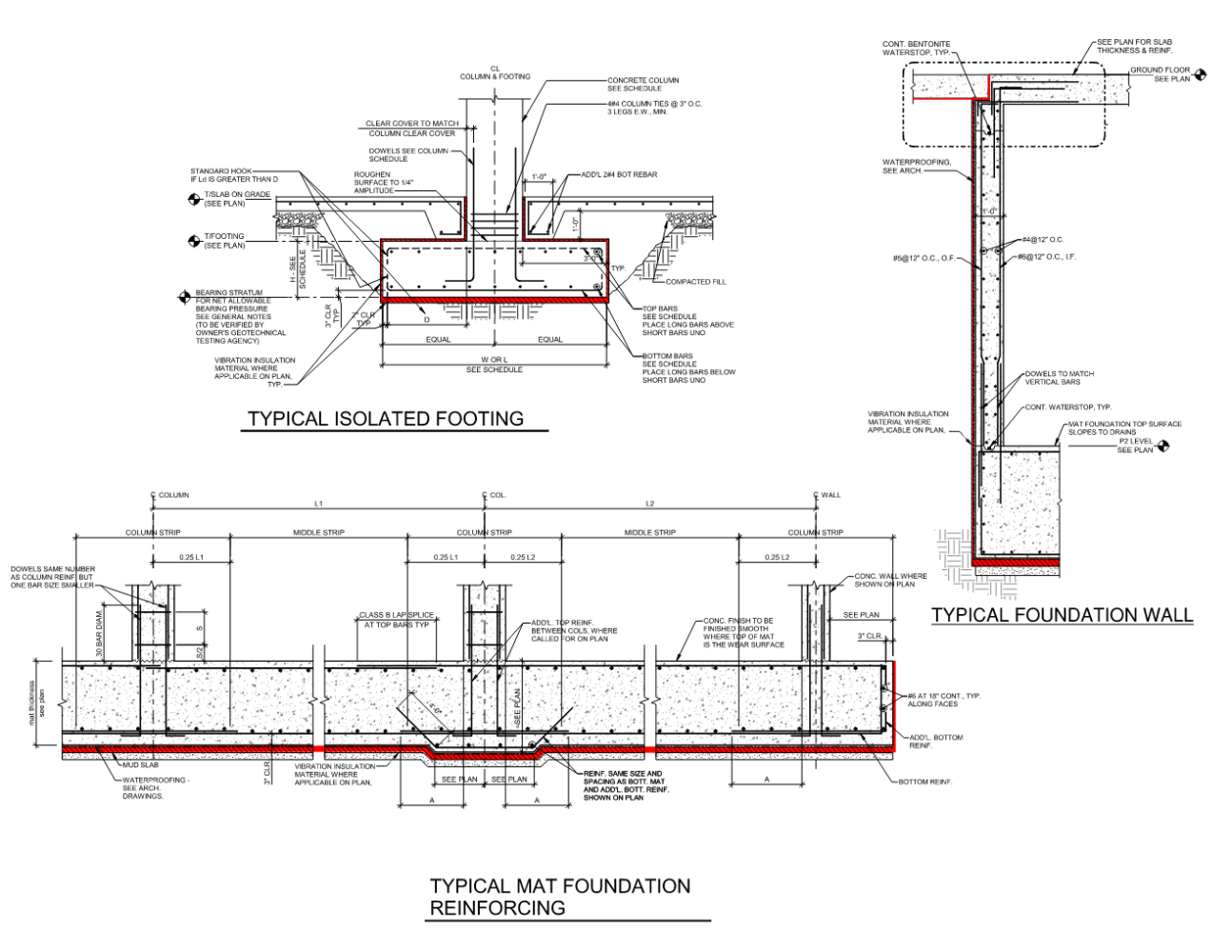
Examples of the elastomeric vibration isolation pads at foundation
What to expect. Done well, elastomeric pads are highly effective against mid-to-high frequency structure-borne noise, exactly the range most guest and occupant complaints fall into, at a fraction of the cost of springs or floating slab systems.
Advise the Team at an Early Stage in Design
- Bring in structural and acoustical teams at feasibility/schematic design. Isolation affects footing geometry, bearing pressures, and construction sequencing and it’s not a late add.
- Match the isolation system to the dominant frequency. Pad and bearing selection lives and dies on the source frequency content, not just the loads.
- Don’t ignore horizontal performance. Many resilient systems handle vertical motion well but let horizontal components through detail tie-beams and shear keys accordingly.
- Account for creep. Elastomeric materials compress under sustained load over time. Specify long-term deformation properties and size pads accordingly.
- Protect against moisture, fire and durability issues. Groundwater, oil exposure, and freeze/thaw cycles all affect material selection.
- Never compromise the lateral load path. Isolation must be coordinated with the seismic and lateral system, factor it into drift calculations and diaphragm design, not around them.
- Define acceptance criteria contractually. The thresholds and target vibration velocities, noise and vibrations should be agreed on up front, not argued about after occupancy.
Verify It Actually Works
- Baseline measurements before construction, both continuous vibration and transient events
- Post-installation verification at guest rooms and sensitive equipment supports, checked against targets
- Ongoing monitoring during pile driving or heavy construction, tracking Peak Particle Velocity (PPV) and logging results for owner/contractor coordination
A Real-World Result
On a high-scale hotel and luxury condominium adjacent to a metro line, we combined elastomeric pads under foundation, mat slab and basement walls near the tunnel alignment. Post-construction testing showed a measurable drop in structure-borne vibration at guest-room floors compared to adjacent buildings.
The Takeaway
Vibration isolation isn’t a specialty add-on, it’s a core design decision that touches structural, geotechnical, and acoustical scopes at once. Elastomeric bearing pads are often the most cost-effective place to start, but the real win comes from treating isolation as part of the baseline design budget, not a contingency line item.
If you’ve got a residential or hospitality project sitting near a transit line or a construction neighbor, this is worth a conversation before the foundations are poured, not after the first guest complaint.
This insight was originally published by Nima Arjomandnia, PE, PMP, on Linked In. View the original post and add your own comments.