An Engineering Insight authored by SK&A Director of Testing and Inspection, Charles Mitchell. Follow Charles on LinkedIn.
Depth, moisture, reinforcing congestion, and radar artifacts can affect what a survey reliably detects.
GPR (Ground Penetrating Radar) has become commonplace in construction because it is fast, safe, and the least destructive method to detect subsurface concrete objects before saw-cutting or core drilling. Many projects today involve modifying existing structures rather than building new ones. When an engineer asks:
- Where can we cut this beam?
- Are there post tensioned tendons in this area?
- What is the reinforcing layout?
- Where can new anchors be installed?
GPR is often the first investigation method used. GPR helps reduce risk and avoid costly surprises when working with existing concrete structures. Construction documents are often incomplete or inaccurate, especially for renovation projects, older buildings, campus facilities, hospitals, and government facilities.
GPR helps verify slab thickness, steel reinforcing spacing, concrete cover depth, foundation locations, and underground structures. This information is invaluable during design and construction. While GPR is an excellent tool, we must recognize its limitations that are sometimes overlooked.
The deeper the target, the weaker the signal.
Typical depths:
- Concrete scanning: typically effective through slabs, beams, and walls up to about 18-24 inches thick.
- Subgrade investigations such as voids: immediately below the concrete slab/soil interface.
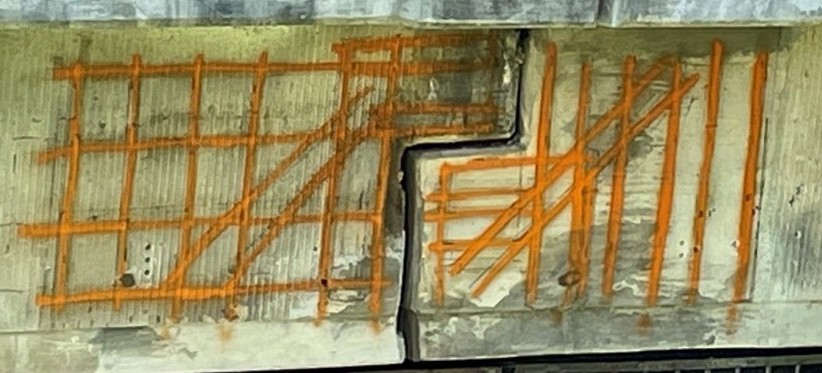
GPR Survey with limited depth range
Shadows
In heavily reinforced concrete, the radar signal can be “shadowed” by upper layers of steel. You may clearly identify the first layer of reinforcement while deeper bars become difficult to distinguish.
Echoes
Echoes or multiples cause one to see objects that may not actually exist. When reviewing radar data from heavily reinforced slabs or PT reinforced slabs, it is common to see a hyperbola followed by one or more weaker hyperbolas directly beneath it. Experienced GPR technicians recognize these as multiples (echoes) rather than additional steel.
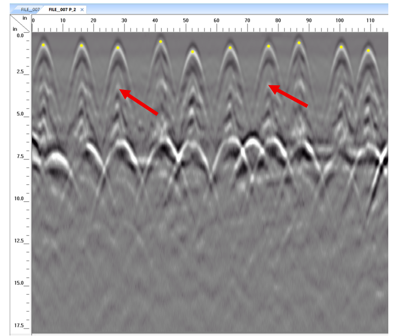
GPR Output with Echoes
Latent Moisture
Moisture within the concrete will influence depth calculations. GPR estimates depth based on radar wave velocity. If the technician assumes an incorrect dielectric constant, then depth estimates will be inaccurate. Water contained in the cement porosity can greatly affect the penetration of radar energy and the strength of the reflected radar signal. Water has a maximum dielectric constant and destroys the radar signal by conducting and reflecting the radar energy randomly. This phenomenon affects what is called the ‘signal floor.’ This is the depth at which the true reflected radar signal is overwhelmed by background noise. Data below the signal floor cannot be relied upon. For this reason, young-aged concretes can be difficult to scan because the signal floor is above the depth of the embedments.
Examples of concrete with moisture and rebar congestion that limited our GPR survey:
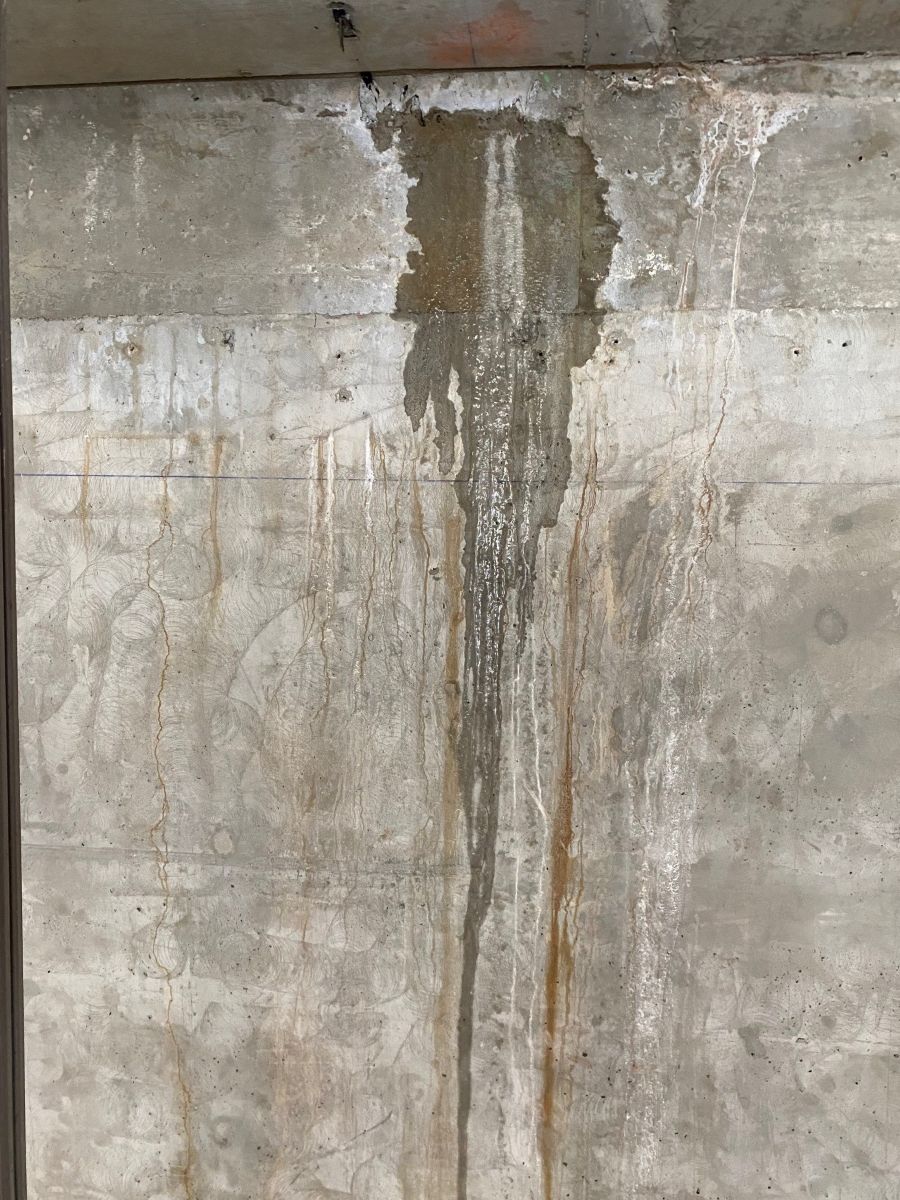
Concrete with moisture
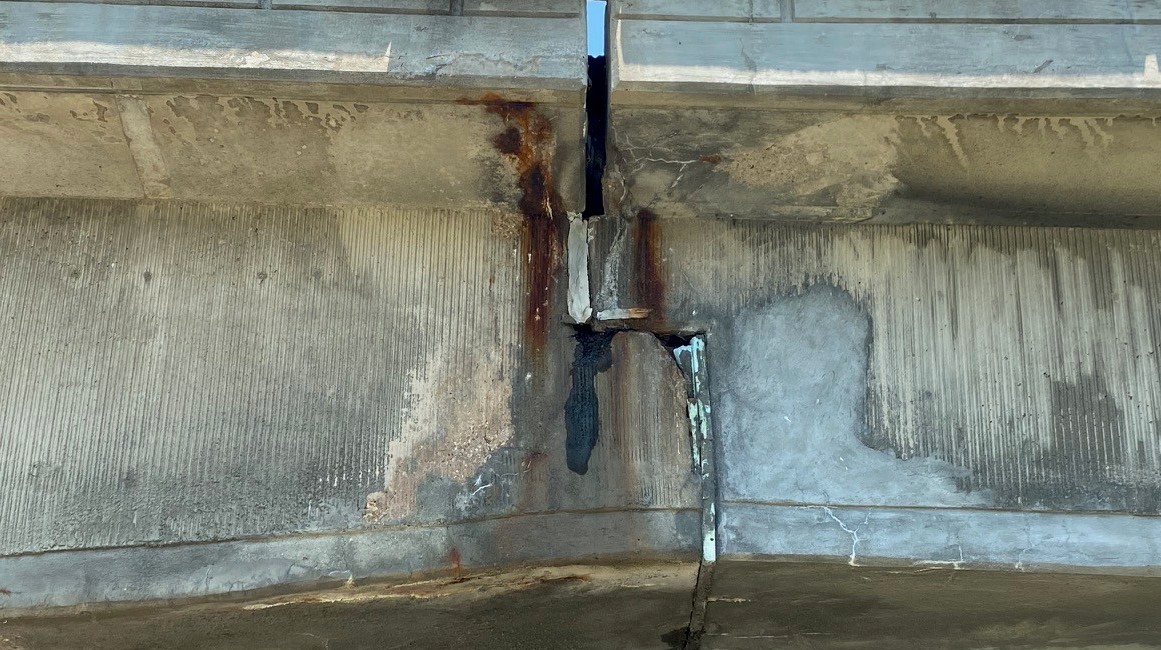
Concrete with moisture and congestion
Void Detection
For slab-on-grade and bridge deck investigations, GPR is combined with sounding, core drilling, or other testing methods. Large voids are often detectable, small voids may not be, moisture-filled voids may be difficult to distinguish, confirmation frequently requires core drilling or other NDT methods.
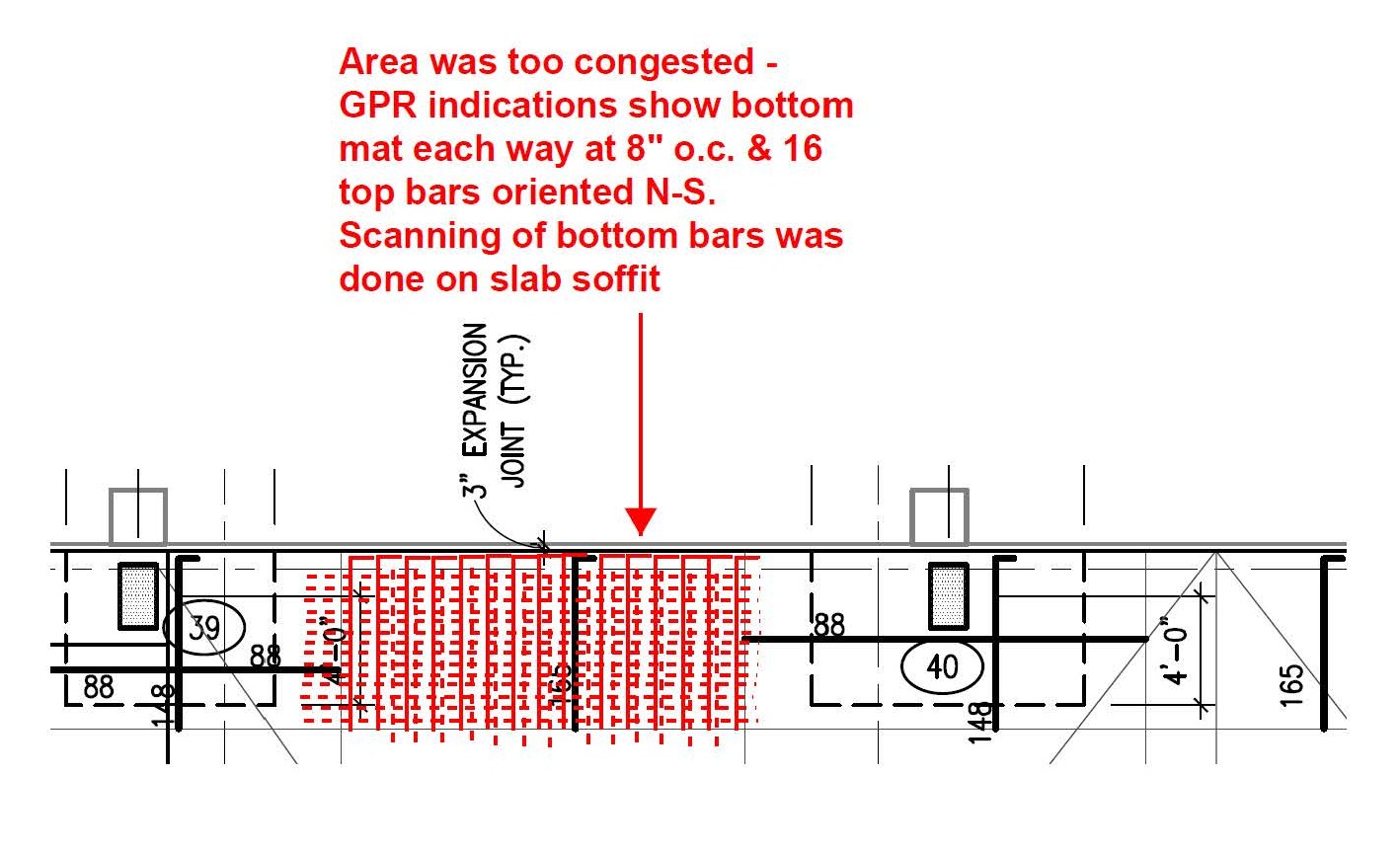
GPR Indications of Congested Slab
An experienced GPR technician is able to communicate these limitations to the client/engineer/contractor clearly so that expectations are managed. GPR detects contrasts in material properties. The hyperbola output will indicate subsurface objects, but it may not distinguish the objects, such as:
- Steel Reinforcing
- Post Tensioned Reinforcing
- PVC Conduits
Interpretation of the GPR output relies heavily on the technician’s experience, object spacing within the concrete, object depth, available structural drawings, correlation with other Non-Destructive Testing and invasive investigation such as core drilling.