Authored by SK&A Principal Justin Long, PE, RBEC, BECxP. Follow Justin on Linked In.
Closing the Loop on High-Performance Enclosures
In last month’s Enclosure Insights, we explored air control — the critical role of continuous air barriers in managing moisture, energy, and occupant comfort. We closed with a fundamental question: if an airtight building is the goal, how do you ensure occupants receive fresh air without reintroducing the very moisture and energy losses you worked so hard to eliminate?
The answer lies in Enthalpy Recovery Ventilation (ERV) — a building science technology that makes high-performance airtight enclosures not only possible, but practical. Understanding how ERVs work, why they matter, and how they integrate with the enclosure is essential for any project team pursuing durable, energy-efficient, and comfortable buildings.
The Airtightness Paradox
High-performance enclosures are designed to be airtight. But airtightness creates a challenge: buildings still require a continuous supply of fresh outdoor air to dilute indoor pollutants, control carbon dioxide levels, and support occupant health. In conventional, leaky buildings, this fresh air arrived uninvited — through cracks, gaps, and poorly sealed joints — alongside uncontrolled moisture and energy loss.
As enclosures have become more airtight, this incidental ventilation has disappeared. Without a deliberate mechanical ventilation strategy, tightly sealed buildings can accumulate indoor pollutants, elevated CO₂, humidity, and volatile organic compounds (VOCs). Airtightness without ventilation does not produce a high-performance building — it produces a sealed box.
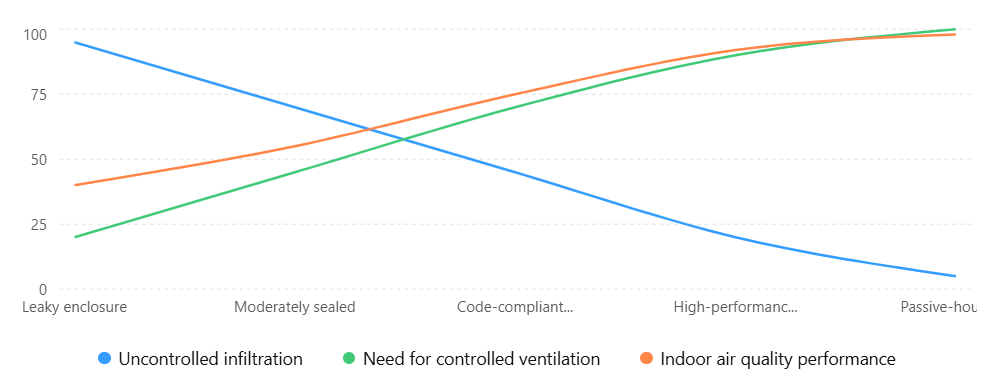
Conceptual diagram illustrating the relationship between airtightness, ventilation rate, and indoor air quality
What Is Enthalpy Recovery Ventilation?
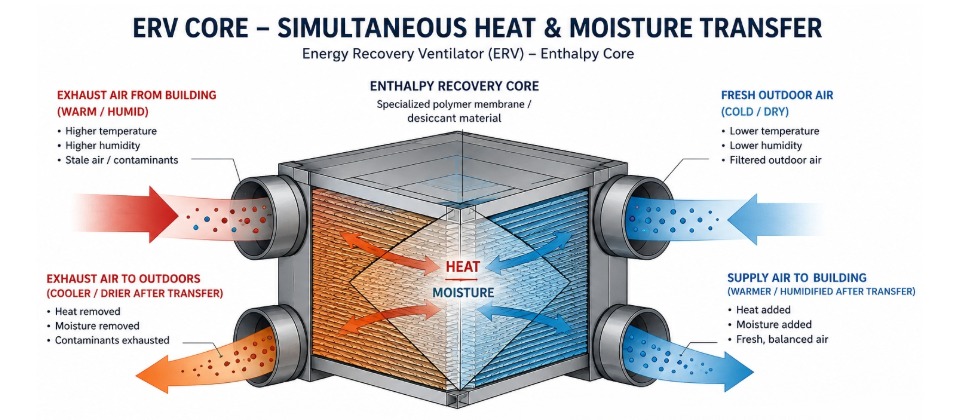
An Enthalpy Recovery Ventilator (ERV) is a mechanical ventilation device that simultaneously exhausts stale indoor air and supplies fresh outdoor air — while transferring both sensible heat (temperature) and latent heat (moisture) between the two airstreams. This exchange occurs across a heat-and-moisture-permeable core, without the two airstreams mixing directly.
This is distinct from a Heat Recovery Ventilator (HRV), which transfers only sensible heat. ERVs transfer both heat and moisture, making them the preferred solution in climates where humidity management is as critical as temperature control — which, in practice, describes most of the climate zones encountered in high-performance building design.
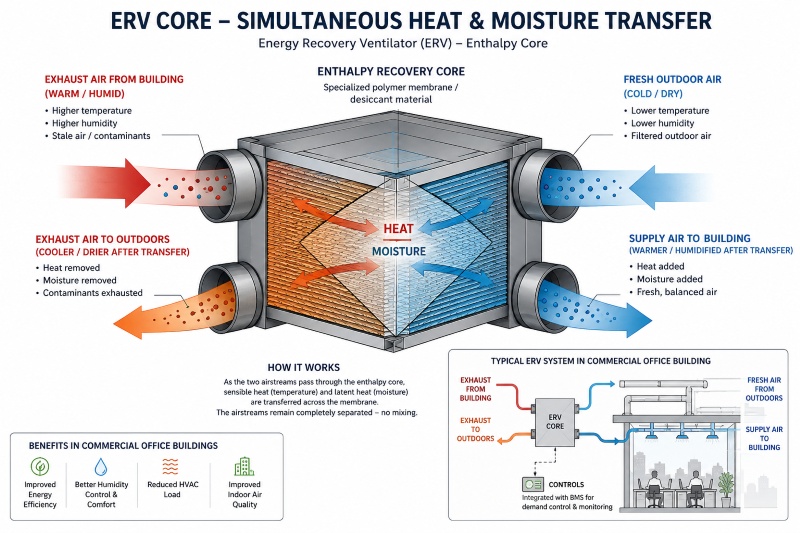
Schematic of ERV Core Illustrating Simultaneous Heat & Moisture Transfer Between Exhaust & Supply Airstreams
The performance of an ERV is characterized by two efficiency metrics:
- Sensible Effectiveness: the percentage of temperature difference recovered between the two airstreams.
- Latent Effectiveness: the percentage of moisture (humidity) recovered between the two airstreams.
High-performance ERV cores typically achieve sensible and latent effectiveness values of 70–85%, depending on unit design, airflow rates, and climate conditions.
How ERVs Interface with the Building Enclosure
The building enclosure and the HVAC system are not independent systems — they are interdependent performance layers. An ERV sits at the interface between these two layers, managing the one pathway through the enclosure that is intentionally open: the mechanical ventilation penetration.
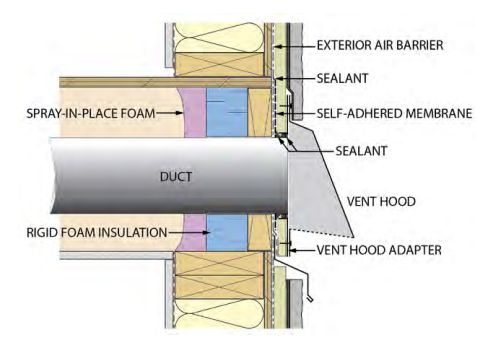
Sample Detail of ERV Duct Penetration at Exterior Wall Assembly
Several enclosure design principles bear directly on ERV integration:
- Air Barrier Penetrations: Every ERV intake and exhaust penetration must be carefully detailed to maintain air barrier continuity. Poorly sealed penetrations can introduce uncontrolled leakage pathways that undermine the very airtightness the ERV is designed to complement.
- Pressure Relationships: ERVs are designed to operate with balanced supply and exhaust airflows, maintaining neutral building pressure. Imbalanced systems — where exhaust exceeds supply or vice versa — can create positive or negative pressure differentials that drive moisture into enclosure assemblies or cause doors and windows to be difficult to operate.
- Humidity Control: By recovering moisture from the exhaust airstream in winter (retaining interior humidity) and pre-conditioning humid outdoor air in summer (limiting moisture introduction), ERVs directly support the enclosure’s humidity management strategy. This reduces the likelihood of condensation within assemblies and helps maintain interior RH within the 40–60% range generally recommended for occupant comfort and enclosure durability.
- Thermal Bridge at Penetrations: ERV supply and exhaust ducts represent penetrations through the thermal control layer. These must be insulated and detailed carefully to prevent thermal bridging, condensation at duct surfaces, or degradation of the continuous insulation plane.
ERVs in the Context of High-Performance Building Standards
The integration of controlled mechanical ventilation — and ERVs in particular — is increasingly codified in high-performance building standards and energy codes. Programs such as ASHRAE 90.1, ASHRAE 62.1, Passive House (PHIUS), and the IECC all address minimum ventilation rates, air leakage limits, and energy recovery requirements in ways that make ERVs not only desirable but often required.
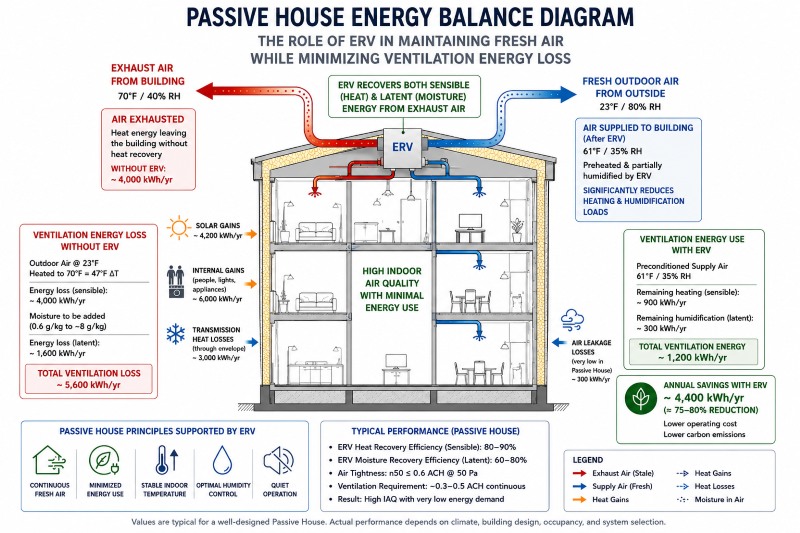
In Passive House design — the most rigorous high-performance enclosure standard currently in widespread use — ERVs are a non-negotiable component of the mechanical strategy. Passive House buildings target air leakage rates of 0.6 ACH₅₀ or less, at which point all fresh air must be delivered mechanically. Without an ERV, achieving that ventilation target would require substantial heating and cooling energy to condition incoming outdoor air — negating much of the benefit of the high-performance enclosure.
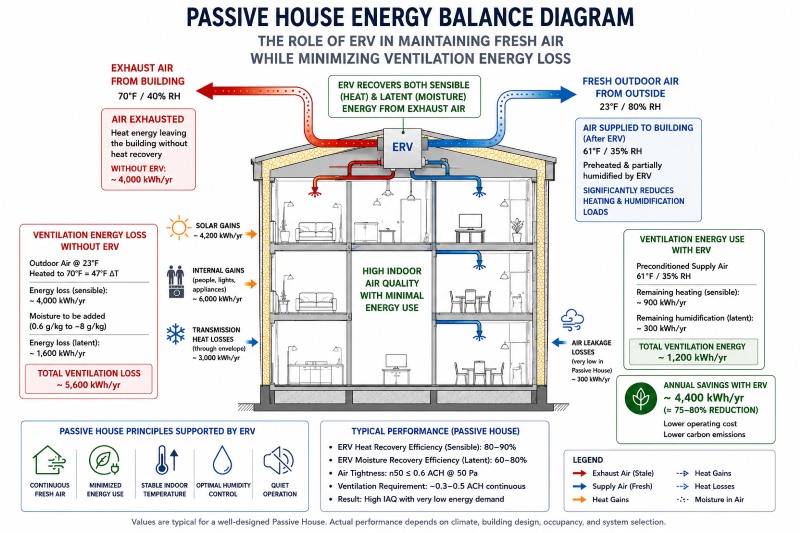
Passive House Energy Balance Diagram Illustrating the Role of ERV in Maintaining Fresh Air While Minimizing Ventilation Energy Loss
Climate Considerations & ERV Selection
Not all ERVs perform equally across all climates, and the selection of an appropriate unit requires careful consideration of local conditions:
- Hot-Humid Climates (e.g., Miami, Houston): Latent effectiveness is paramount. High outdoor humidity must be pre-conditioned before introduction to the building interior to prevent excess moisture loading on cooling systems and enclosure assemblies.
- Cold Climates (e.g., Minneapolis, Chicago): Sensible effectiveness is critical. ERVs must recover heat efficiently from exhaust air. Frost control strategies — such as pre-heaters, defrost cycles, or recirculation modes — must be incorporated to prevent core icing at low outdoor temperatures.
- Mixed Climates (e.g., Washington D.C.): Both sensible and latent performance matter seasonally. ERV core selection should reflect the full range of annual conditions, including shoulder seasons where neither heating nor cooling dominates.
The enthalpy wheel, fixed-plate polymer core, and rotary heat exchanger are the most common ERV core technologies. Each has distinct performance characteristics, maintenance requirements, and suitability for different climate zones and occupancy types. Coordination between the enclosure consultant, mechanical engineer, and energy modeler is essential to ensure that the selected unit performs as intended under real operating conditions.
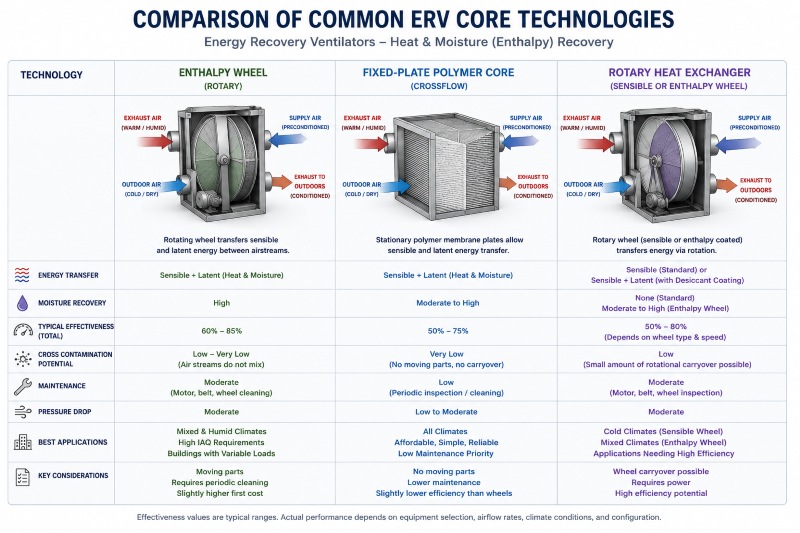
Comparison of Common ERV Core Technologies – Enthalpy Wheel, Fixed-Plate Polymer Core & Rotary Heat Exchanger
Commissioning & Performance Verification
As with air barriers, specifying an ERV is not sufficient — performance must be verified. Commissioning of ERV systems should confirm:
- Design airflow rates at supply and exhaust outlets
- Balanced pressure relationships across the building enclosure
- Proper sealing of all duct penetrations through the air barrier
- Frost control operation (in cold climates)
- Measured sensible and latent effectiveness relative to manufacturer specifications
Commissioning data should be incorporated into the Building Enclosure Commissioning (BECx) process to ensure that the mechanical ventilation strategy and enclosure airtightness are verified together — not independently. A building that passes a whole-building air leakage test but operates with an improperly commissioned ERV has not achieved its intended performance.
Why This Matters
The relationship between airtightness and ventilation is one of the most consequential — and most frequently misunderstood — aspects of high-performance enclosure design. When properly integrated:
- ERVs enable buildings to be sealed tightly against uncontrolled air and moisture movement
- Fresh air delivery is controlled, filtered, and pre-conditioned
- Humidity levels remain within ranges that support both occupant comfort and enclosure durability
- Ventilation energy losses are minimized, preserving the energy benefits of the high-performance enclosure
- Indoor air quality is maintained predictably — independent of wind, stack effect, or HVAC pressurization
The enclosure and the mechanical system are not competing disciplines. In high-performance buildings, they are co-dependent performance layers that must be designed, detailed, and commissioned as a unified system.
- A building that is airtight but poorly ventilated trades one set of problems for another.
- A building that is well-ventilated but leaky cannot control humidity, energy, or indoor air quality.
- Only when airtightness and enthalpy recovery work together does the high-performance enclosure deliver on its promise.
What’s Next in Enclosure Insights
In the next installment of Enclosure Insights, we will shift from air control to thermal control — exploring how continuous insulation, thermal bridge elimination, and dew-point control work together to create truly high-performance wall and roof assemblies.
SK&A’s Building Enclosure Consulting + Waterproofing team brings decades of experience and specialized technical expertise to aid in the design and construction of new buildings, as well as the evaluation and maintenance of existing buildings. Learn more.