An Engineering Insight authored by SK&A Associate Monika Crandall, PE, LEED AP. Follow Monika on Linked In.
Understanding code-required reviews and the value of owner-initiated review
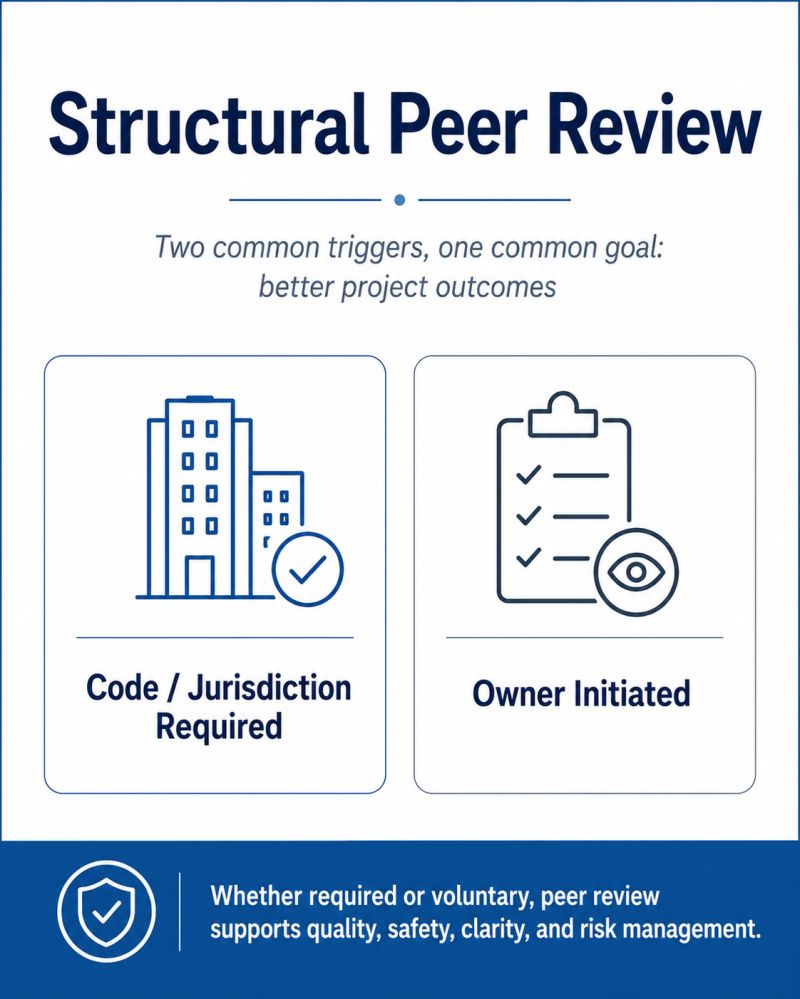
A structural peer review is not always a code requirement, but it is a smart risk-management tool. Not all structural peer reviews are triggered for the same reason.
Sometimes, a peer review is required by the building code, the local jurisdiction, or a public agency. This is often the case for projects that involve performance-based design, nonlinear analysis, unusual structural systems, tall buildings, or designs that are intended to demonstrate equivalent performance rather than follow a purely prescriptive path.
In those cases, the peer review is part of the formal approval process. The reviewer is typically independent, qualified for the specific structural system or hazard being evaluated, and tasked with confirming that the design criteria, analysis approach, assumptions, and final documents are consistent with the intended performance objectives.
But peer reviews can also be initiated by the owner, even when they are not required by code. That type of review serves a different, but a very valuable, purpose. An owner-triggered peer review can provide an additional level of confidence before construction. It gives the project another experienced set of eyes to look at the drawings, calculations, specifications, load paths, constructability, coordination, and areas where the design intent may need to be clarified. The goal is not to second-guess the design team or simply generate redlines. A good peer review should be collaborative, project-specific, and focused on improving the outcome.
When done early enough in the process, peer review can help identify issues before they become construction changes, schedule delays, or costly field problems. It can also help confirm that the structural approach is appropriate for the project’s complexity and that critical assumptions are clearly communicated.
For more complex projects, the value is even greater when the review begins during conceptual or schematic design, when major decisions about structural systems, configuration, and design criteria are still being made. Waiting until the final drawing set often limits the review to comments on documentation rather than meaningful input on the structural approach.
Whether required by code or requested by the owner, peer review is ultimately about risk management, quality, safety, and clarity. In structural engineering, a second set of qualified eyes is not a sign of weakness in the design process. It is one of the ways we make the process stronger.
This insight was originally published by Monika Crandall, PE, LEED AP, on Linked In. View the original post and add your own comments.