An Engineering Insight authored by SK&A Associate Monika Crandall, PE, LEED AP. Follow Monika on Linked In.
Same Roof, Different Snow Drift Loads
Snow drift is not “extra snow everywhere.” It is a concentrated load that shows up at roof steps, parapets, screen walls, and re-entrant corners — which means these are often architectural decisions first and structural checks second.
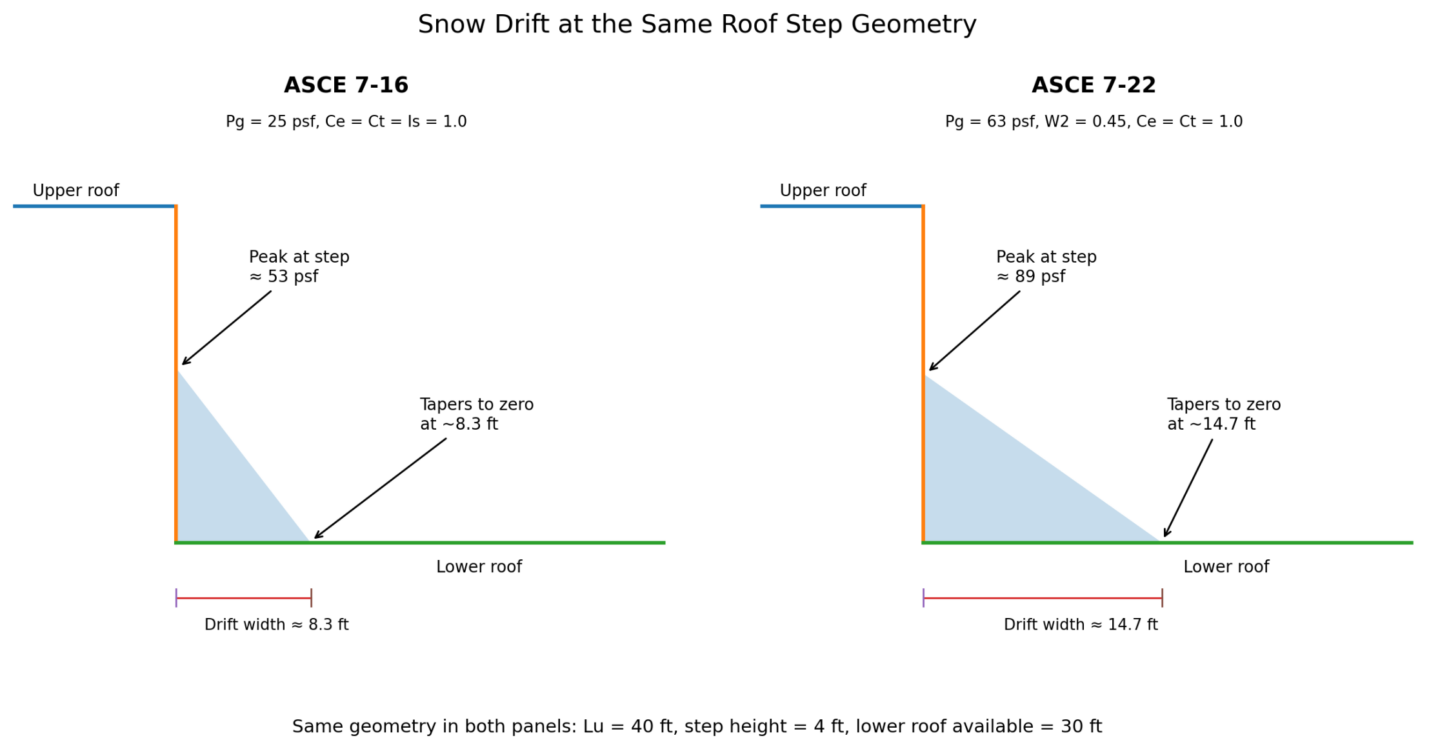
Here is the same roof-step drift example run two ways for Washington, DC:
- Upwind fetch (Lu): 40 ft
- Step height: 4 ft
- Lower roof available before obstruction: 30 ft
Results of ASCE 7-16 vs 7-22
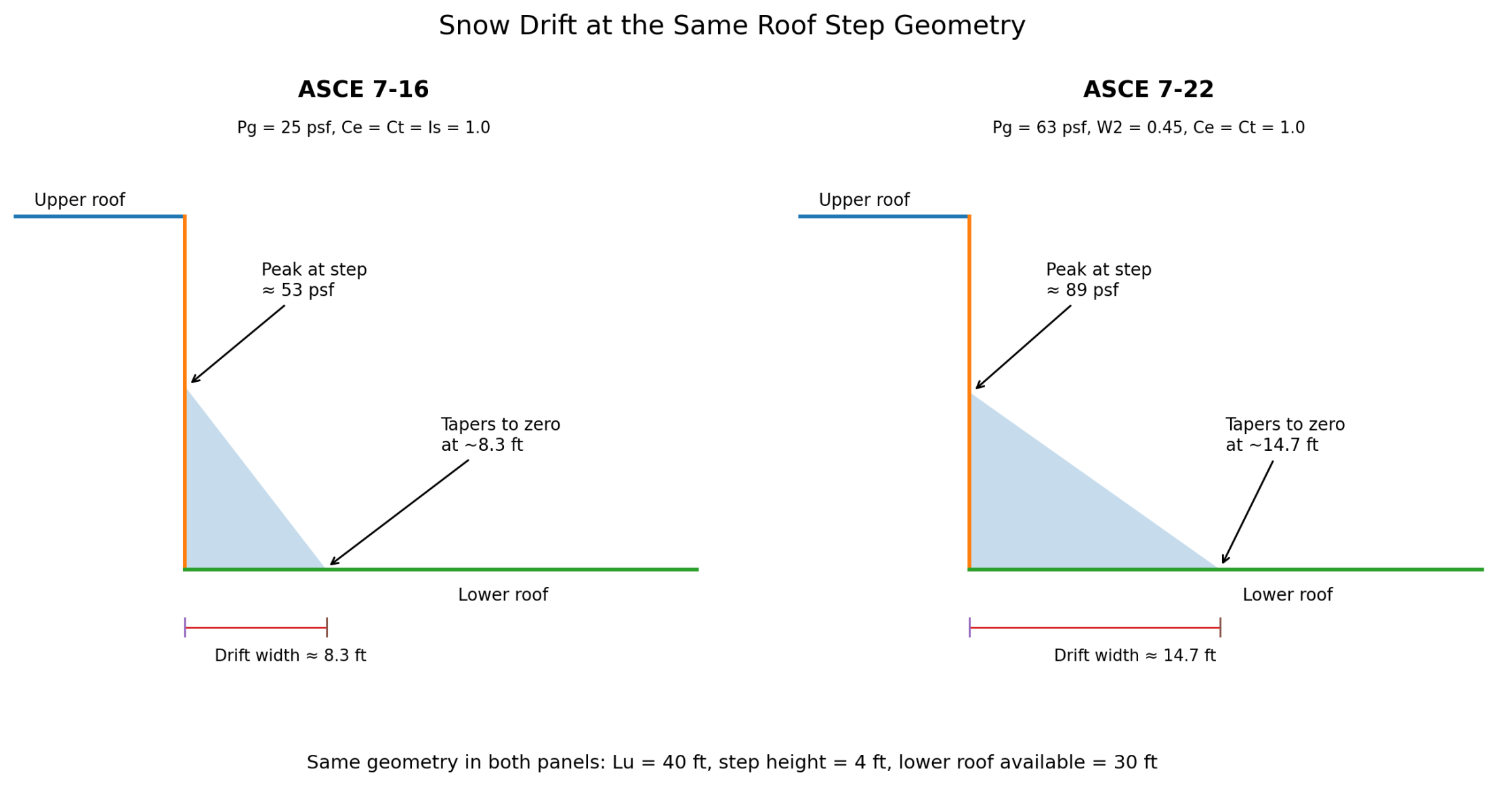
- ASCE 7-16 style (using DC’s 25 psf minimum): Peak drift snow ≈ 53 psf
- ASCE 7-22 style (using Hazard Tool values for DC, Risk Cat II: Pg = 63 psf, W2 = 0.45): Peak drift snow ≈ 89 psf
Same roof geometry. Same step. Very different peak load at the drift.
Let’s take it apart
ASCE 7-16
Using Pg = 25 psf (DC minimum snow load language), and common factors Ce = 1.0, Ct = 1.0, Is = 1.0:
- Balanced roof snow pf=0.7CeCtIspg=0.7(1)(1)(1)(25)=17.5 psfp_f = 0.7 C_e C_t I_s p_g = 0.7(1)(1)(1)(25) = 17.5 \, psfpf=0.7CeCtIspg=0.7(1)(1)(1)(25)=17.5psf
- Snow density γ=0.13pg+14=0.13(25)+14=17.25 pcf\gamma = 0.13p_g + 14 = 0.13(25)+14 = 17.25 \, pcfγ=0.13pg+14=0.13(25)+14=17.25pcf
- Drift height (classic 7-16 form) hd≈0.43Lu1/3(pg+10)1/4−1.5h_d \approx 0.43L_u^{1/3}(p_g+10)^{1/4}-1.5hd≈0.43Lu1/3(pg+10)1/4−1.5 With Lu=40L_u=40Lu=40 ft and pg=25p_g=25pg=25, hd≈2.08 fth_d \approx 2.08 \, fthd≈2.08ft
- Peak drift surcharge pd=γhd=17.25(2.08)≈35.8 psfp_d = \gamma h_d = 17.25(2.08) \approx 35.8 \, psfpd=γhd=17.25(2.08)≈35.8psf
- Peak total snow at the step pmax=pf+pd=17.5+35.8≈53.3 psfp_{max} = p_f + p_d = 17.5 + 35.8 \approx \mathbf{53.3 \, psf}pmax=pf+pd=17.5+35.8≈53.3psf
ASCE 7-22
Using Pg = 63 psf and W2 = 0.45 for DC Risk Cat II (your inputs), with common factors Ce = 1.0, Ct = 1.0: (ASCE 7-22 adds W2 to drift and removes the snow importance factor from the flat-roof equation.)
- Balanced roof snow pf=0.7CeCtpg=0.7(1)(1)(63)=44.1 psfp_f = 0.7 C_e C_t p_g = 0.7(1)(1)(63) = 44.1 \, psfpf=0.7CeCtpg=0.7(1)(1)(63)=44.1psf
- Snow density γ=0.13(63)+14=22.19 pcf\gamma = 0.13(63)+14 = 22.19 \, pcfγ=0.13(63)+14=22.19pcf
- Balanced snow depth hb=pf/γ=44.1/22.19≈1.99 fth_b = p_f/\gamma = 44.1/22.19 \approx 1.99 \, fthb=pf/γ=44.1/22.19≈1.99ft
- Available drift height at a 4-ft step hc=hs−hb=4.0−1.99=2.01 fth_c = h_s – h_b = 4.0 – 1.99 = 2.01 \, fthc=hs−hb=4.0−1.99=2.01ft
- Drift height (7-22 equation includes W2) The calculated drift height is greater than the available clear height, so the drift is cap-controlled at the step. (That cap is what governs the final peak here.)
- Peak drift surcharge pd=γhc=22.19(2.01)≈44.7 psfp_d = \gamma h_c = 22.19(2.01) \approx 44.7 \, psfpd=γhc=22.19(2.01)≈44.7psf
- Peak total snow at the step pmax=pf+pd=44.1+44.7≈88.8 psfp_{max} = p_f + p_d = 44.1 + 44.7 \approx \mathbf{88.8 \, psf}pmax=pf+pd=44.1+44.7≈88.8ps
Why such a difference?
ASCE 7-22 makes snow drift more location-specific by including winter wind exposure (W2) and using updated hazard values. In this example, the practical takeaway is simple: before we all panic over the jump in snow loads, let’s not forget the snow load factor reduction!
This insight was originally published by Monika Crandall, PE, LEED AP, on Linked In. View the original post and add your own comments.