Authored by SK&A Principal Justin Long, PE, RBEC, BECxP. Follow Justin on Linked In.
The building science behind condensation, vapor control, and durable enclosure design
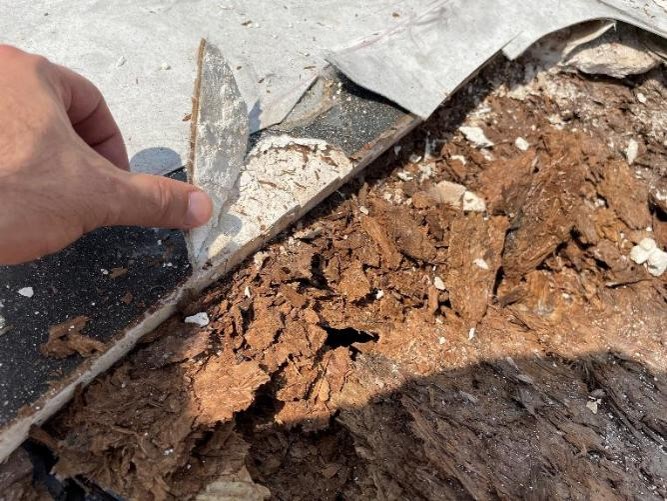
While bulk water infiltration is often the most prominent cause of enclosure failures, humidity-driven moisture is one of the most persistent and misunderstood sources of long-term enclosure failure. Vapor movement, condensation, and limited drying potential can quietly undermine wall and roof assemblies – often without obvious symptoms until significant damage or mold-growth is discovered.
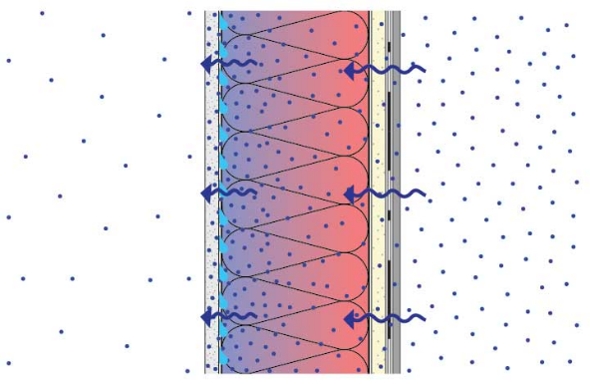
Conceptual Cross-Section of Typical Wall Assembly Representing Relationship between Relative Humidity, Air Movement, Vapor Diffusion, Thermal Insulation & Condensation
Understanding how relative humidity, air movement, vapor diffusion, and thermal insulation interact is essential to designing durable enclosures and maintaining interior comfort.
Air/Vapor, Condensation, & Drying Potential
Air movement is the primary mechanism by which water vapor is transported through enclosure assemblies, and it typically contributes far more moisture to walls and roofs than vapor diffusion alone. When air leaks through cracks, joints, penetrations, or discontinuities in the air barrier, it carries with it the full moisture content of that air mass. Even small pressure differentials – caused by wind, stack effect, or HVAC pressurization – can drive significant volumes of moisture-laden air into or through assemblies.
Compared to vapor diffusion, which is a relatively slow molecular process, air leakage can move orders of magnitude more moisture in a short period of time. For this reason, uncontrolled air movement is often the dominant contributor to interstitial condensation and concealed moisture accumulation.
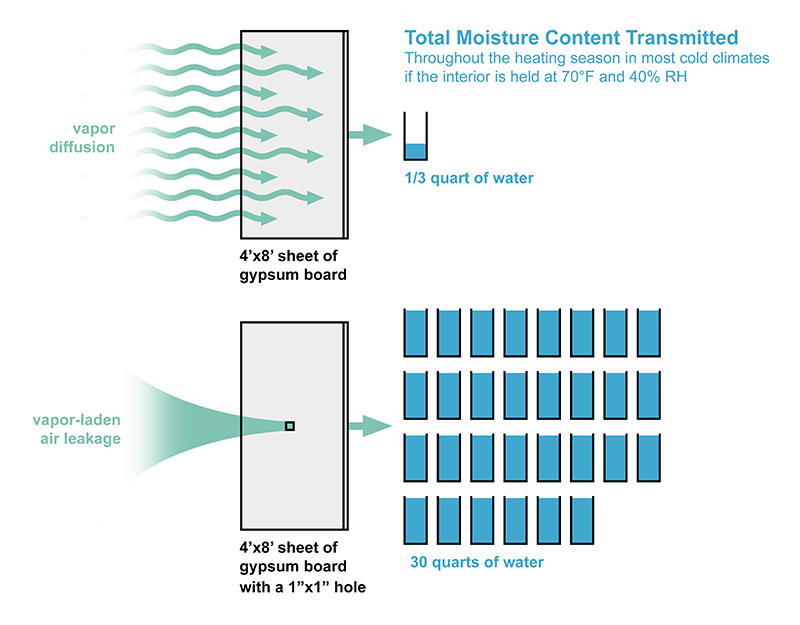
View of Total Moisture Transmission through Air Leakage vs. Vapor Diffusion – Photo Credit: Building Enclosure Online, Daniel Overbey
Water vapor is always present in air. When that moisture moves through enclosure assemblies – via air movement, vapor diffusion, or a combination of both – it can condense if it encounters a material surface at or below the dew point temperature. This process is governed by the interconnected relationship between temperature, relative humidity (RH), and pressure differentials.
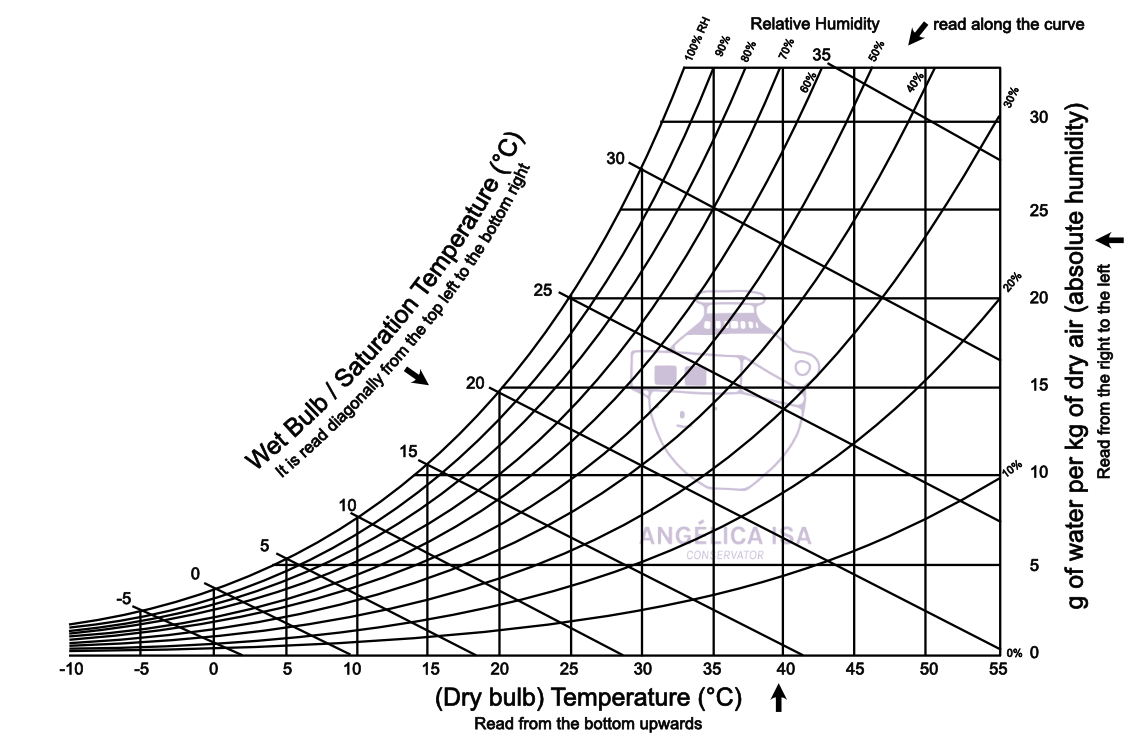
View of Psychrometric Chart – A Graphical Representation of How Air Temperature, Moisture Content, and Energy Relate to Dew Point Condensation
In general, condensation occurs:
- During heating periods, when warm, moist interior air migrates outward toward colder exterior surfaces
- During cooling periods, when hot, humid exterior air migrates inward toward cooled interior environments
Warm air can hold more moisture than cold air; as air cools, its capacity to retain moisture decreases. When the temperature drops to the dew point corresponding to a given RH, water vapor transitions to liquid water. Within enclosure assemblies, this typically occurs at cold surfaces such as exterior sheathing during winter conditions or interior-facing surfaces during cooling-dominated summer conditions.
Once condensation occurs, this liquid water is absorbed by the adjacent materials within the assembly (i.e., wood, insulation, gypsum board, etc.). If our assemblies lack sufficient drying potential, repeated wetting events can lead to excessive moisture accumulation and subsequent material degradation, corrosion, and biological growth.
Vapor Permeability & Material Selection
The vapor permeability of materials plays a central role in how assemblies manage moisture:
- Class I vapor retarder (i.e., “vapor barriers”) (≤0.1 perms) are essentially vapor-impermeable
- Class II vapor retarders (0.1 – 1.0 perms) limit vapor diffusion while allowing some drying
- Class III vapor retarders (1.0 – 10.0 perms) allow significant vapor movement & drying

View of Common Examples of Class I, II & III Vapor Retarders
Selecting the wrong class – or placing it incorrectly within an assembly – can trap moisture within assemblies rather than protect them. The appropriate vapor retarder strategy depends on climate, occupancy, HVAC operation, insulation levels, and expected vapor drive direction.
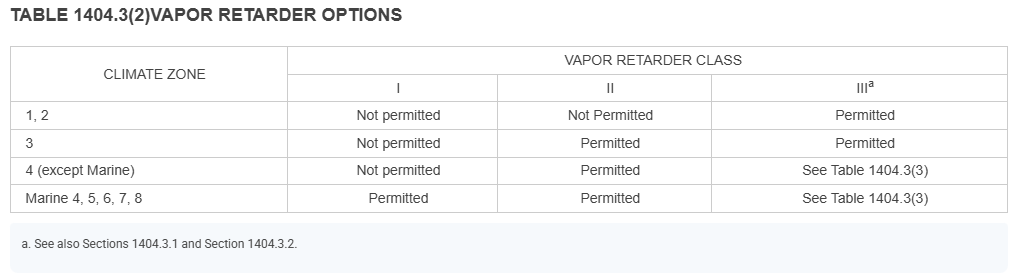
View of IBC (2021) Table 1404.3 Which Outlines Permissibility of Each Class of Vapor Retarder Based on Climate Zone
Location of Vapor Retarders in Exterior Assemblies
Equally important as material selection is where vapor retarders are located within the wall or roof assembly. Vapor control layers should be positioned to limit condensation risk at cold surfaces while still permitting drying in at least one direction.
Misplaced vapor retarders – particularly in mixed or humid climates – can prevent assemblies from drying seasonally, leading to chronic moisture problems even in otherwise well-detailed enclosures.
Insulation, Temperature Gradients, and Condensation Risk
While insulation is a critical requirement for energy performance, excessive or poorly placed insulation can inadvertently increase condensation risk. By shifting temperature gradients deeper into an assembly, insulation can move dew-point conditions onto vulnerable substrates such as sheathing, framing, or other porous materials.
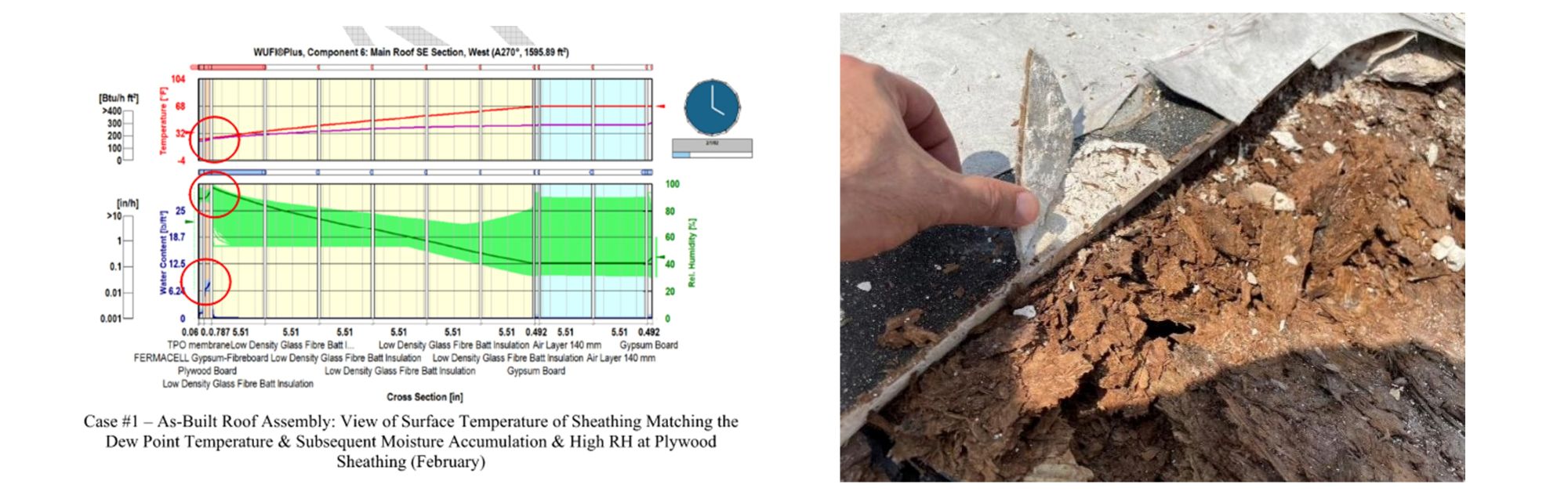
View of Hygrothermal Cross-Section (Left) Illustrating How Excessive Insulation within Roof Truss Cavities Maintains Cold Surface Temperatures at the Roof Sheathing Resulting in Condensation, Subsequent Moisture Accumulation, and Degradation of Roof Sheathing (Right)
This is why insulation values, continuity, placement, and thermal bridging must be evaluated together with air/vapor control and drying potential – not in isolation.
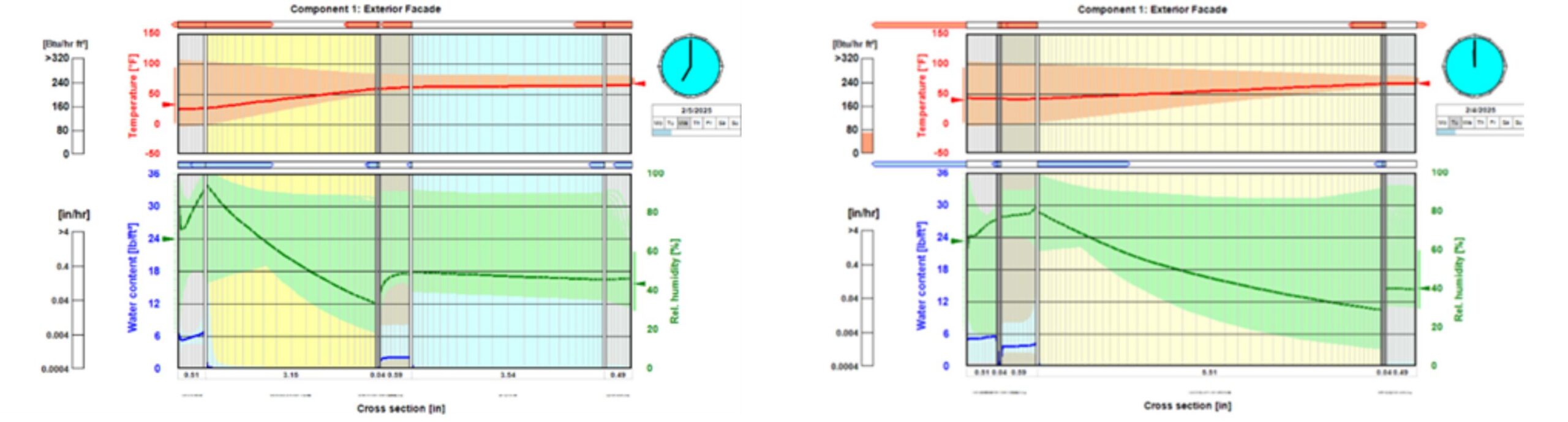
View of Comparative Hygrothermal Performance of Traditional Stud Wall w/ 5 ½” Batt-Insulation & Class II Vapor Retarder (Left) vs. 3” Continuous Insulation w/ No Cavity Insulation or Vapor Retarder (Right)
Conditions That Facilitate Mold Growth & Corrosion
The presence of moisture alone is not enough to necessarily cause failure. However, these wet conditions create localized environments with elevated RH and higher dew points further reducing their drying potential which can lead to mold growth and corrosion. Mold growth & corrosion typically require:
- Sustained relative humidity levels above ~70-80%
- Repeated or prolonged wetting without drying
- Moderate temperatures
- Availability of oxygen & organic matter
When enclosure assemblies remain at elevated relative humidity levels for extended periods, materials can corrode, and organic materials may support mold growth that affects both durability & indoor air quality.
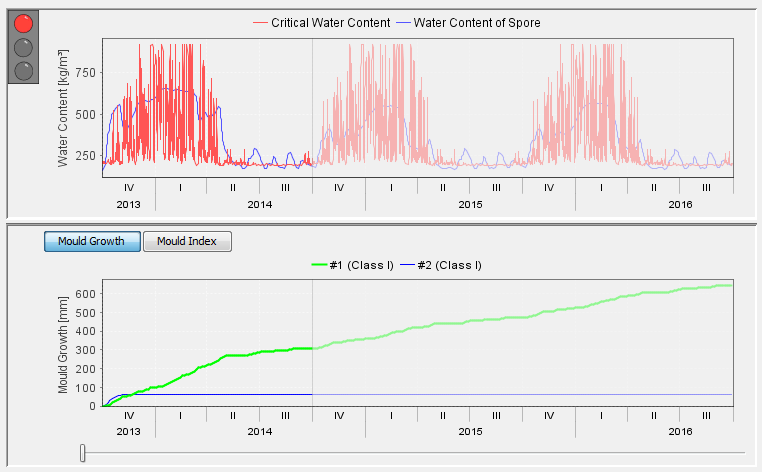
View of Mold Growth Potential Analysis via WUFI Bio®
The Critical Role of HVAC & Internal Loads
Humidity control is not solely an enclosure issue – it is a shared responsibility between the enclosure and HVAC systems. Mechanical design directly influences condensation risk & drying capacity through parameters such as:
- Heating & cooling setpoints
- RH control strategies
- Air change rates (i.e., ventilation)
- Pressurization schemes
Internal moisture loads can further complicate enclosure performance. Spaces such as gyms, locker rooms, bathrooms, kitchens, laboratories, healthcare facilities, and natatoriums can introduce significant moisture loads that must be accounted for in terms of enclosure and HVAC design. Assemblies that perform well for offices or residential spaces may fail rapidly under higher internal moisture loads if not properly designed and coordinated.
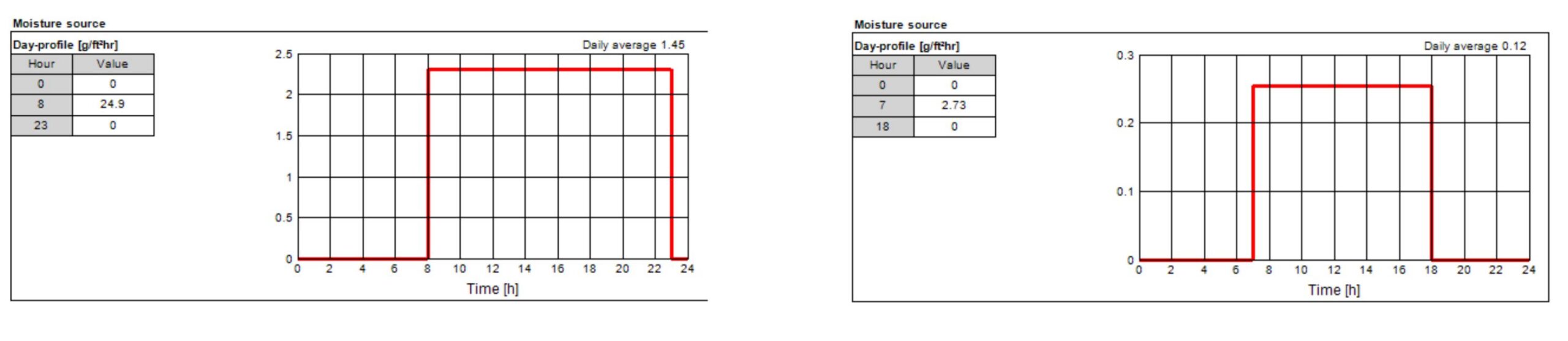
Comparison of Internal Moisture Profiles – Fitness Room (Left) & Open Office Space (Right)
A Systems-Based Approach to Humidity Control
Design teams & enclosure consultants must evaluate enclosure durability through the combined lens of:
- Understanding moisture transportation via air movement & vapor diffusion
- Vapor permeability & drying potential of materials & assemblies
- Seasonal wetting & drying behavior of assemblies
- Insulation levels, placement, & dew-point control
- HVAC systems & internal moisture loads
By understanding how these factors interact, project teams can design enclosures that manage moisture-laden air safely, reduce the potential for condensation, remain durable over time, and support occupant comfort rather than compromise it.
What’s Next in Enclosure Insights
In the next installment of Enclosure Insights, we will dive deeper into the physics and building science principles related to material moisture. We will explore how materials absorb, transmit, store, and release moisture through the properties of permeability, capillarity, and drying potential.
SK&A’s Building Enclosure Consulting + Waterproofing team brings decades of experience and specialized technical expertise to aid in the design and construction of new buildings, as well as the evaluation and maintenance of existing buildings. Learn more.