Authored by SK&A Principal Justin Long, PE, RBEC, BECxP. Follow Justin on Linked In.
How materials absorb, transport, and release moisture, and why it matters for enclosure design
In previous Enclosure Insights posts, we examined two (2) primary moisture drivers:
- Bulk water infiltration (liquid water entering assemblies)
- Humidity-driven moisture and condensation (water vapor, transported by air & diffusion, becoming liquid within assemblies)
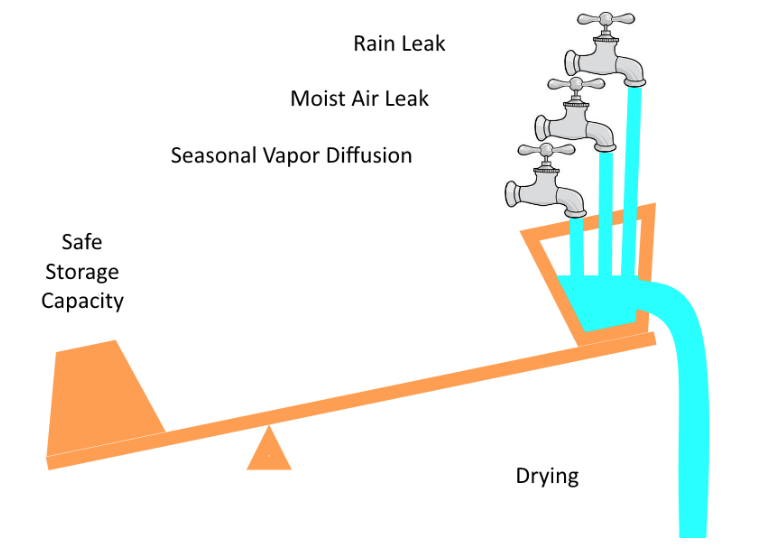
Graphical Representation of the Proper “Balance” between Moisture Loads and a Material’s Ability to Store & Safely Dissipate that Moisture
The next element in understanding the durability of the building enclosure subject to these moisture drivers is the behavior of the materials themselves.
Even when bulk water is controlled and condensation risk is reduced, assemblies perform or fail based on how the materials absorb, transmit, store, and release moisture. That behavior is governed by three fundamental characteristics:
- Permeability
- Porosity/Capillarity
- Drying Potential
Understanding these properties – along with how temperature, relative humidity (RH), vapor pressure, and air pressure influence them – is essential to designing durable exterior assemblies.
Understanding how relative humidity, air movement, vapor diffusion, and thermal insulation interact is also key to designing durable enclosures and maintaining interior comfort.
Material Permeability – Vapor Diffusion Through Materials
Permeability refers to a material’s ability to allow water vapor (gas, not liquid water) to diffuse through it. This movement is driven by vapor pressure differentials, which are directly related to:
- Temperature
- Relative Humidity (RH)
- Air Pressures
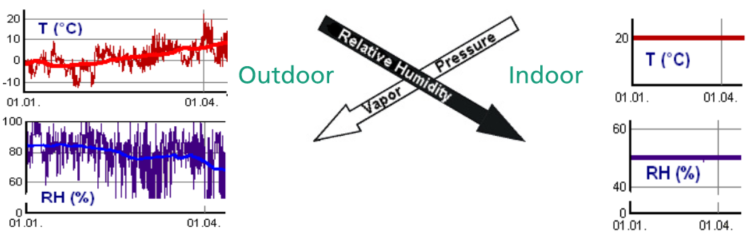
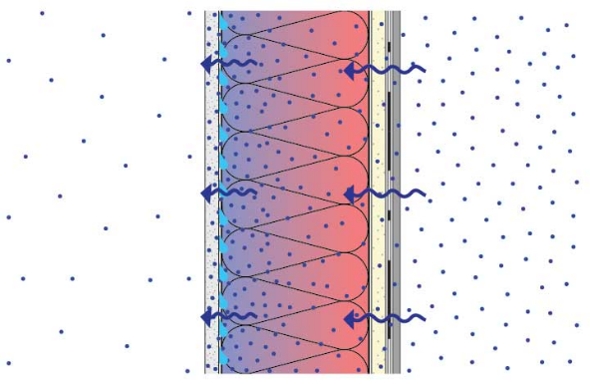
The Diffusion of Moisture Vapor Typically Moves from High-to-Low in Terms of Relative Humidity, Temperature, and Air Pressure
For example, warm air holds more moisture than colder air. If the indoor temperature & RH is higher than the exterior environment, a vapor diffusion will occur from the interior to the exterior due to the vapor pressure differential that is created.
As we all know, material permeability varies significantly and is typically categorized as vapor-impermeable (i.e., Class I “vapor barriers” – 0.1 perms or less), semi-permeable materials (Class II “vapor retarders” – 0.1 to 1.0 perms), and vapor-open materials (Class III “vapor retarders” – 1.0 to 10 perms). But the permeability of materials is not static. Many materials are temperature- and humidity-dependent – in other words, their permeance can increase at higher RH levels. This means assemblies may behave differently once saturated or under seasonal/occupancy-driven moisture loads.
The implication for design professionals and building enclosure consultants is that discussions centered around controlling vapor diffusion should be focused on climate, interior loads, desired drying direction, and material properties – not simply on introducing a vapor retarder within an assembly. For example, an exterior wall assembly comprised of wood studs and OSB sheathing will control vapor diffusion differently than one comprised of light-gauge steel studs and gypsum (all else being equal in terms of insulation, AWB, and cladding).
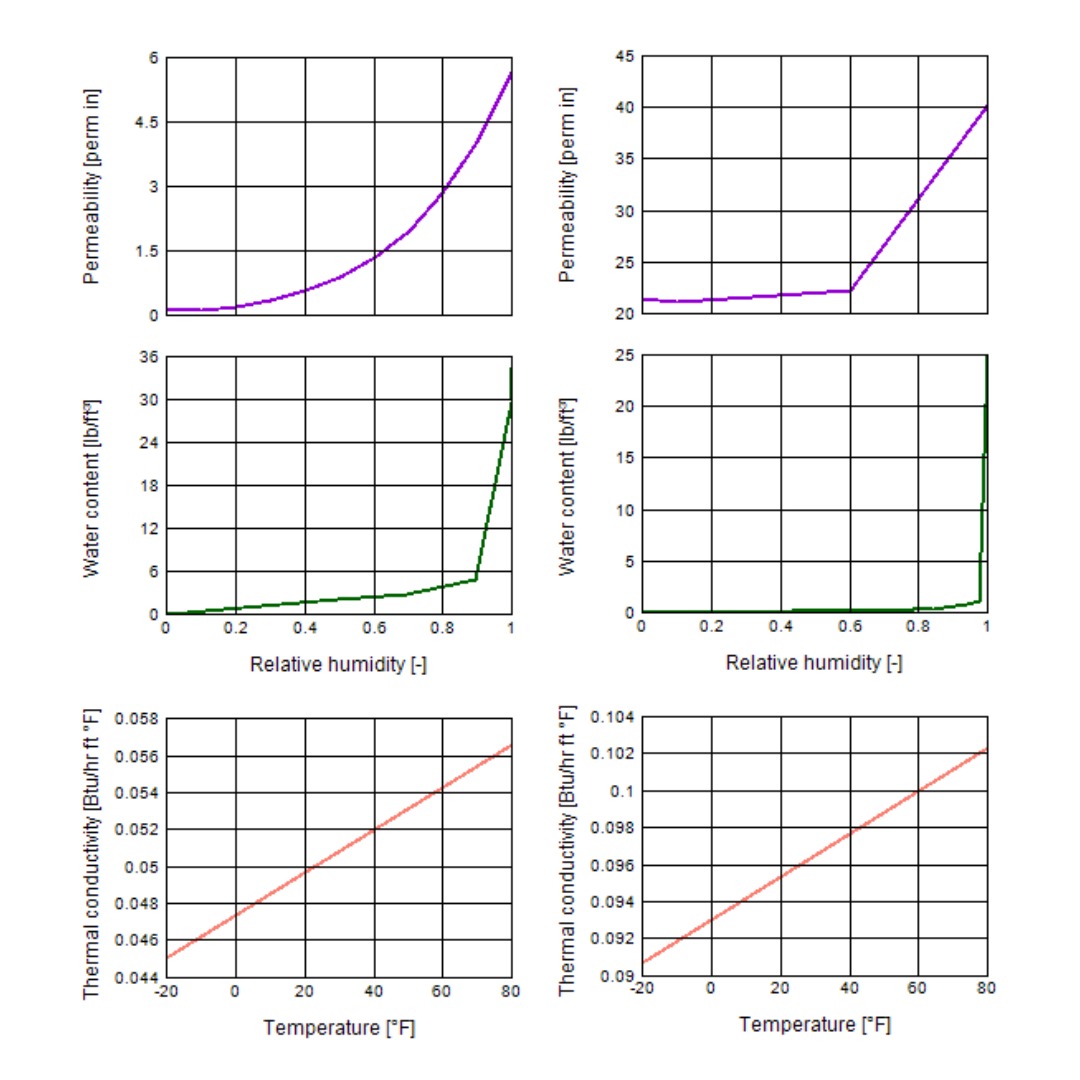
View of Material Property Differences Between Plywood (Left) and Gypsum Board (Right) in Terms of Vapor Permeability & Water Content as a Function of Relative Humidity
Capillarity – Liquid Water Movement Through Porous Materials
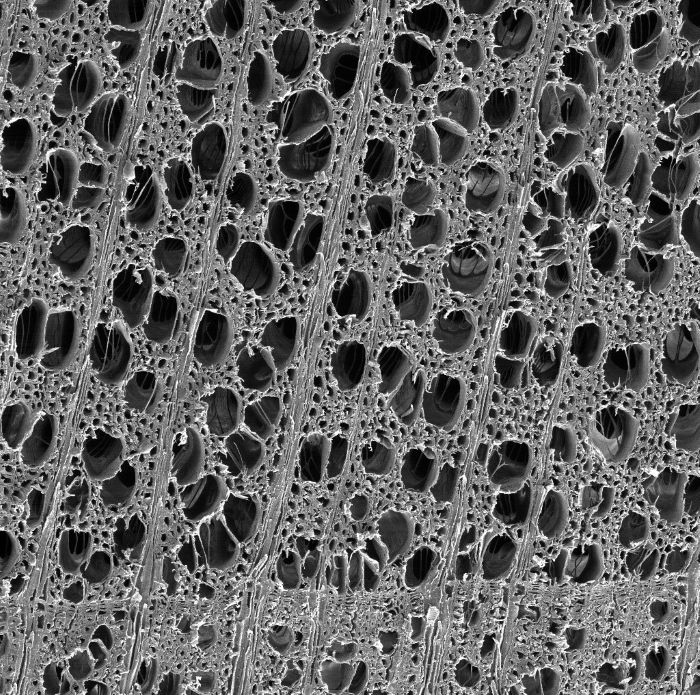
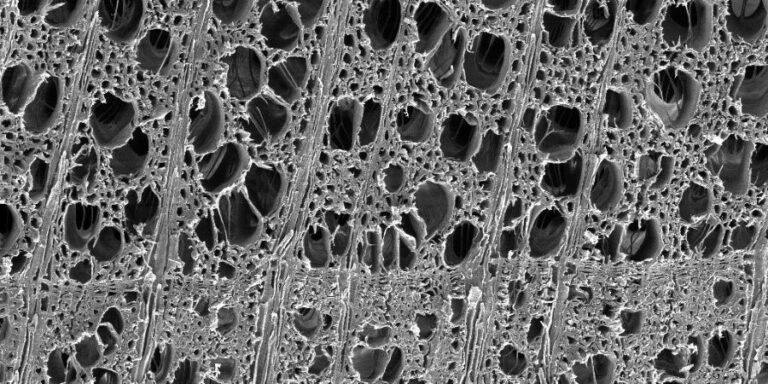
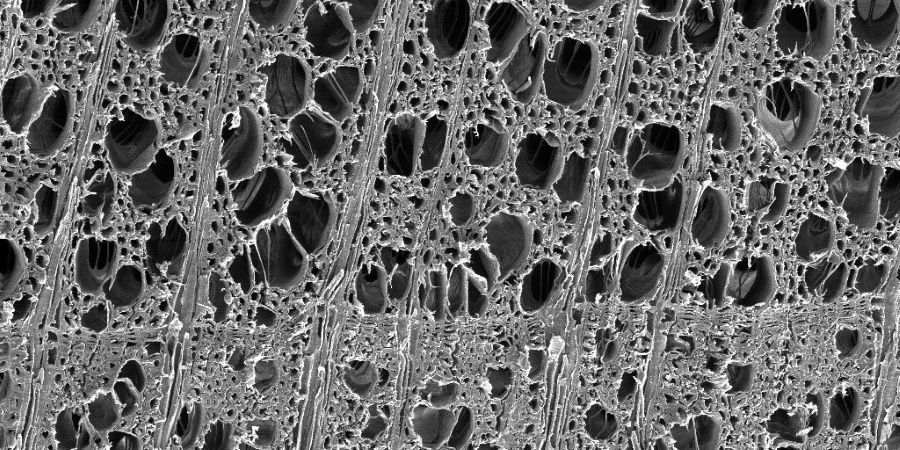
View of Microscopic Pore Structure of Wood
Capillarity refers to the ability of porous materials to absorb and transport liquid water through the microscopic pore structure of the materials. Hygroscopic materials (materials that attract and retain water through absorption) such as concrete, brick masonry, mortar, wood, and insulation can draw water inward – even against the forces of gravity.
While vapor diffusion is relatively slow, capillary transport can move moisture rapidly once liquid water is present. This is why drainage, flashing, and water shedding (as discussed in our previous Enclosure Insights) remain critical. To further complicate things, the partial saturation of the material pore structure often leads to capillary suction (i.e., liquid water movement inward despite outward vapor diffusion & drying).
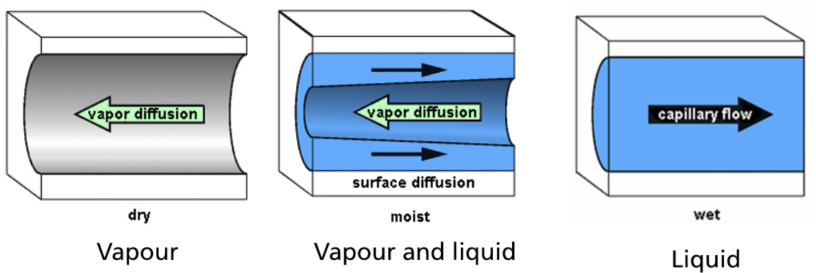
Diagram illustrating moisture transport mechanisms in porous materials: typical vapor diffusion in dry conditions, combined vapor diffusion and surface diffusion in moist conditions, and capillary flow in fully saturated (wet) conditions.
The takeaway for design professionals and building enclosure consultants is that assemblies must prevent sustained exposure to liquid moisture and the capillarity of materials must be considered. It should always be assumed that materials within an assembly will get wet – either due bulk water entry or humidity-driven moisture & condensation. Where porous materials are present, capillary breaks need to be considered to disrupt water migration pathways.
Drying Potential – The Ability to Release Moisture
No enclosure remains perfectly dry at all times. The critical question is not whether wetting occurs – but whether assemblies can dry safely & predictably.
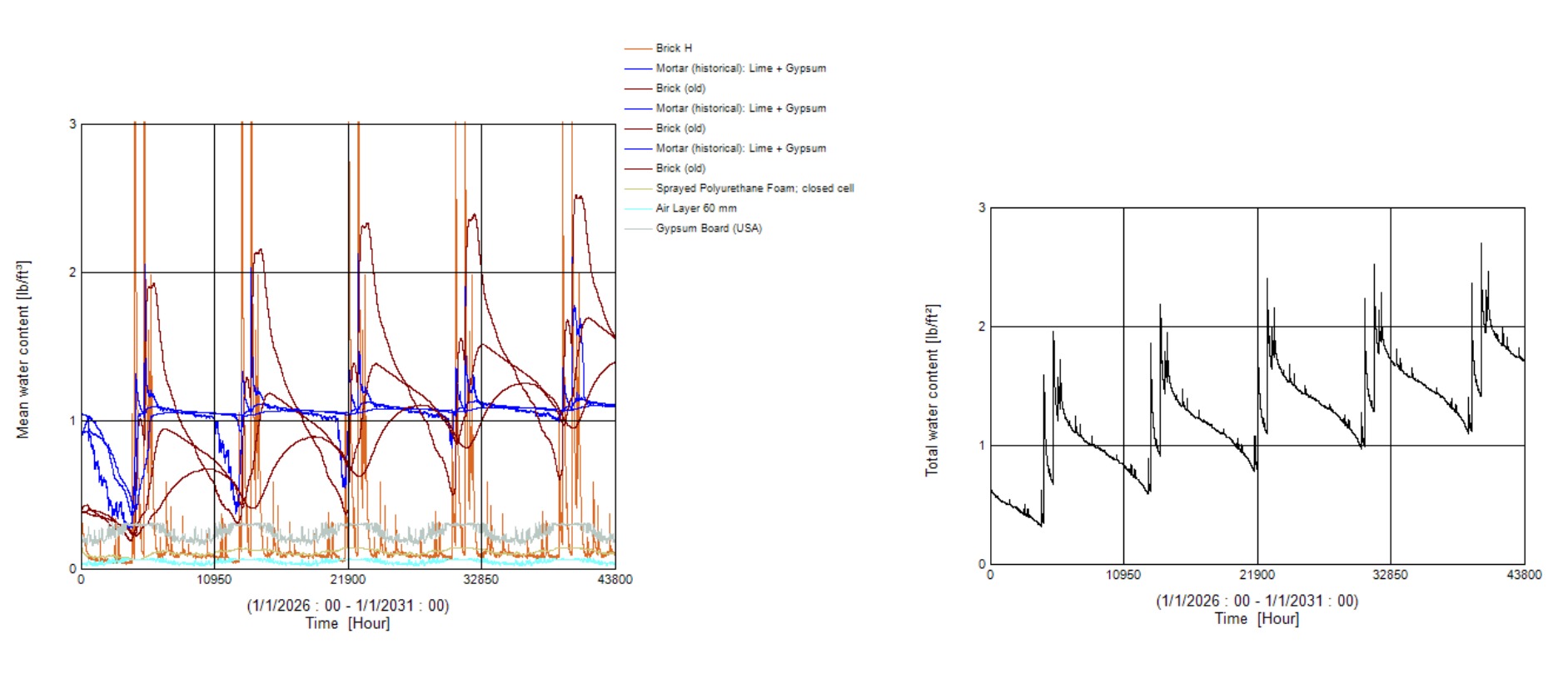
Hygrothermal analysis results depicting incremental moisture content accumulation in materials (left) and the assembly as a whole (right) over a 5-Year period due to excessive ccSPF insulation and limited drying potential
The drying potential of enclosure assemblies depends on:
- Material & assembly permeability
- Temperature gradients
- Direction of vapor diffusion
- Air movement
- Solar radiation
- HVAC-induced pressures
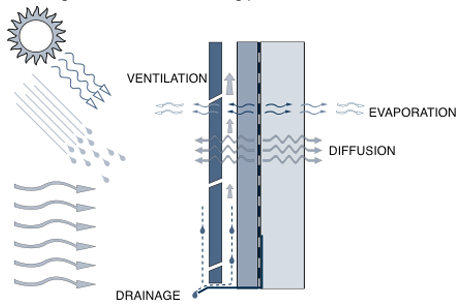
Illustration of the Various Mechanisms Involved with Drying Potential
Drying occurs via vapor diffusion, controlled air transport (ventilation), solar-driven evaporation, and heat flows. If both sides of an assembly are vapor-tight, or if temperature gradients trap the dew point within the impermeable layers, moisture accumulation becomes progressive rather than temporary.
The takeaway for design professionals and building enclosure consultants is that assemblies should always be evaluated for wetting, moisture accumulation, and drying potential across seasonal conditions.
How RH, Vapor Pressure, Air Pressure & Temperature Influence Material Moisture
These environmental variables govern all three moisture mechanisms. Here is a cheat sheet:
- Relative Humidity (RH): Higher RH increases vapor pressure and raises condensation risk. Sustained RH above ~70-80% also facilitates mold growth and corrosion.
- Vapor Pressure: The true driving force behind vapor diffusion – it is a function of temperature and moisture content.
- Air Pressure: Drives infiltration & exfiltration, which transports far more moisture than vapor diffusion alone.
- Temperature: Controls dew point location, vapor pressure magnitude, drying rates, and material permeability behavior.
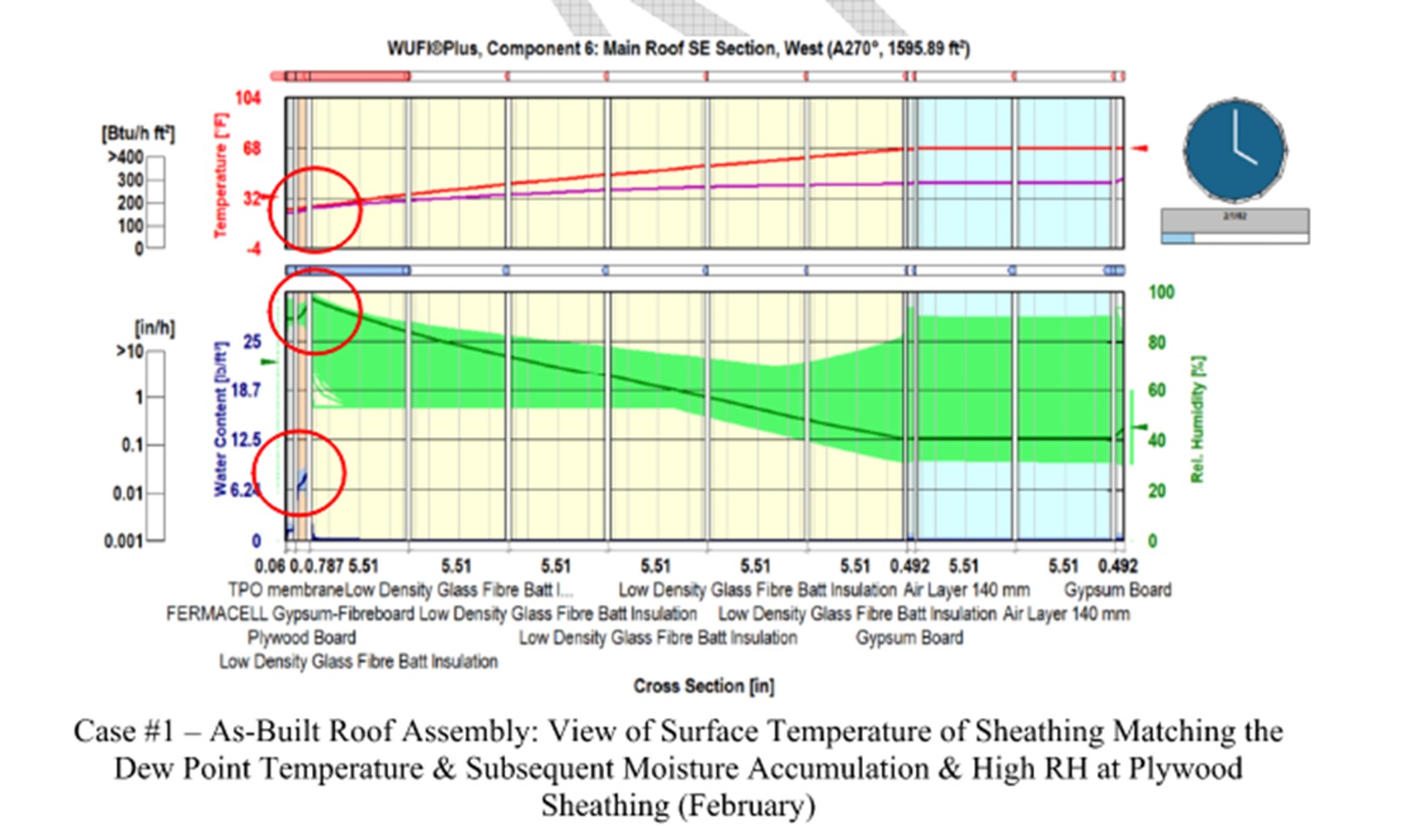
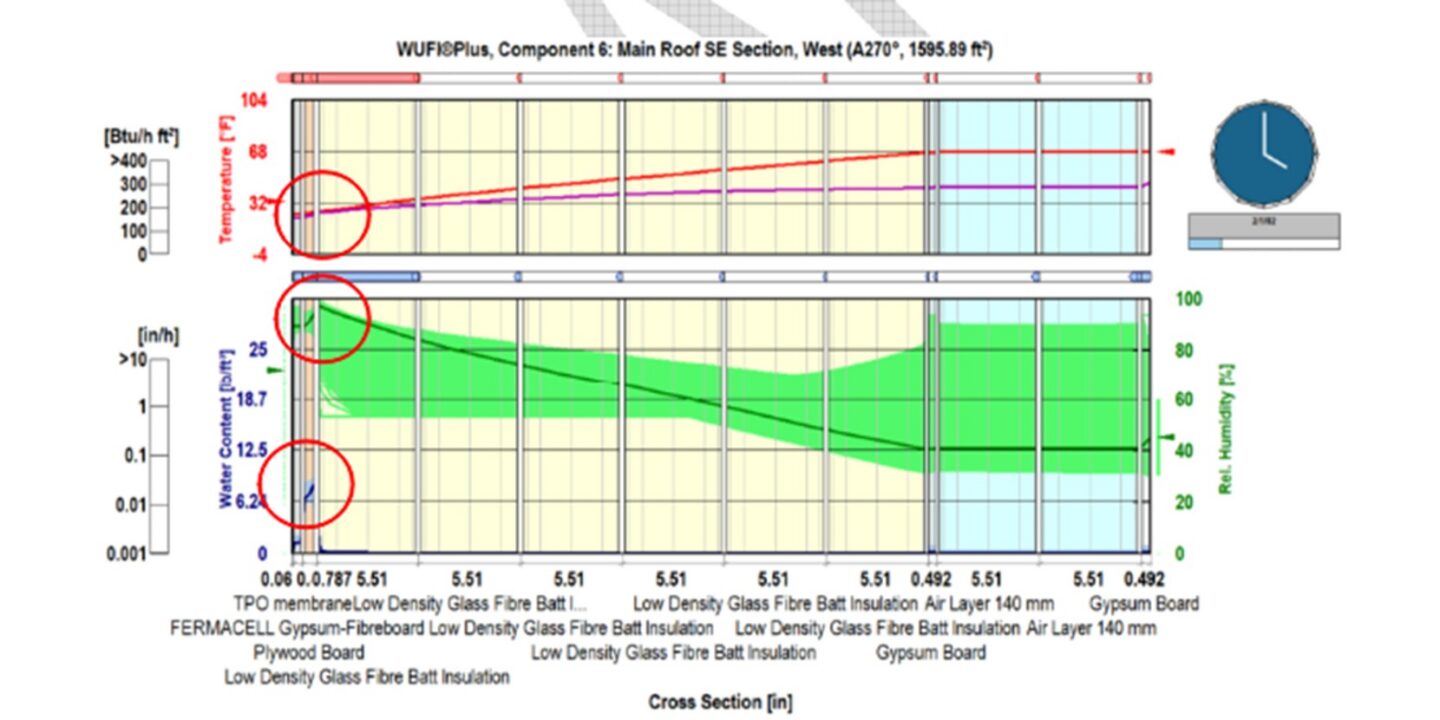
Hygrothermal Cross-Section of Wood-Framed Roof Assembly Illustrating Moisture Accumulation Due to Uncontrolled Air Leakage and Corresponding RH, Thermal Gradient and Dew Point
When these variables are not understood and misaligned with enclosure design assumptions – or when seasonal conditions and HVAC operation changes over time – assemblies may behave very differently than intended.
Connecting the Dots
- Bulk water control prevents liquid water intrusion
- Humidity and condensation control manages air & vapor-driven moisture risks.
- Material moisture management determines whether assemblies can safely absorb, redistribute, and release moisture.
These three design principles are inseparable.
- An assembly that resists rain but cannot dry will fail.
- A vapor-closed assembly in a high-humidity occupancy will accumulate hidden moisture.
- A building with uncontrolled air leakage will transport moisture into enclosure assemblies.
Durable building enclosures are not defined by a single membrane or detail – they are defined by how materials, moisture mechanisms, and environmental conditions interact over time.
What’s Next in Enclosure Insights
In the next installment of Enclosure Insights, we will begin exploring air control by first understanding the importance of continuous air barriers, what materials constitute an air barrier, and how air barriers are inspected & validated in the field.
SK&A’s Building Enclosure Consulting + Waterproofing team brings decades of experience and specialized technical expertise to aid in the design and construction of new buildings, as well as the evaluation and maintenance of existing buildings. Learn more.